Search

Tampilkan postingan dengan label comfort food. Tampilkan semua postingan

Senin, 30 September 2013

California, Here We Go.


We've been plotting and planning for close to eight months. We've been roommates with boxes and bubble wrap for about as many weeks. Address changes, car selling, new banks, lists and lists and lists, goodbye breakfasts, lunches and dinners, goodbye glasses (that turned into bottles) of wine – all of this, leading up to a moment. The moment we drive away from the City of Angels towards our new home, three thousand miles away in Richmond, Virginia. And that moment happened last Thursday.

It was so hurried and frenetic, nary a moment for goodbye tears or nostalgia. Which suited me just fine. Fred, Eduardo, Byron and I all loaded up in our little car, loaded with our life for the next few weeks - not without grandma Janie's cast-iron skillet and my bacon drippings. Ahead warp zillion! Ahead first to Phoenix, Arizona, where we were set to meet up with the legendary Chris Bianco, creator of what is purported to be the greatest pizza on Earth outside of Italy. And then what next? We were not certain. And that is the beauty. We are like Hansel and Gretel, eating those breadcrumbs all along the trail across this great country to find our way home.

After experiencing a wonderful dinner at Chris' newest iteration of Pizzeria Bianco (which you will be able to read and see all about on TasteSpotting soon!), we popped up bright and early to meet up with him at his cafe and 'test kitchen' of sorts, Pane Bianco. This is where his brother, Marco, bakes the loaves of bread and also where the mill lives. Yes, they grow their own wheat, have their own mill, and bake their own bread with their very own flour.


After a tour of the kitchen, dining room and mill, with tastes of biscotti here, and gelato there, Chris sat with us and talked about love and the beauty in everything, and what inspires him (of which food is but a slice). He talked about rectangles, triangles and circles (everything in Pane Bianco is on wheels). He then sent us on our way with hugs, a bottle of chilled rosé from his restaurant (the label is from a painting his father gave his mother ages ago, of a rose) and told us to pick out one of the loaves that had just come out of the oven – to pick the one 'that spoke to us.'


And on the road we went. To infinity: The Grand Canyon. Where we went to watch the sunset, crack open the bottle of rosé, and eat that beautiful fresh bread with some Italian cheeses we picked up in Flagstaff. And yes, the bread was remarkable – mouth-injuringly crusty on the outside, yet moist, airy and filled with beautiful air pockets on the inside – fundamentally satisfying in every way. I suppose Marco was right, it 'spoke to us.' All this while watching the sun disappear into the canyon. How remarkable was it? So much so that I have goose bumps even writing this.


The next morning we were up bright and early to get on the road again. We needed to make it to Albuquerque, at least. Which shouldn't have been too much of a challenge, but Fred wanted to amble. So we stopped at Meteor Crater, walked the dogs, looked around, took pictures. And then we were off again. Well, for about thirty minutes. When I noticed the car slowing considerably, I looked up and found that Fred had pulled off into a small town. And we were driving down the main drag: Route 66.


Fred turned to me and flatly explained (as though it was quite obvious), “I want to be standin' on a corner in Winslow, Arizona."

Oh, of course. Clearly.


We pulled over, leashed up the pups and went to find The Corner. It wasn't hard to find. After Fred posed for his obligatory picture, we began to wander and stumbled across none other than the 15th Annual Standin' on a Corner Festival. What are the chances?!


So we found a vendor selling Navajo Tacos on Fry Bread, wandered back to the car and had our lunch. As we sat in the sun, noshing this new kind of taco, I looked around and thought about Chris' words from earlier. I ruminated on unexpected beauty, I looked down at my pizza-shaped taco loaded with meat, cheese, tomatoes, green onion, lettuce and salsa with the fry bread confidently glistening with hot oil, I relished the love of Fred and our dogs on this singular adventure. I then looked up and saw a bird fly over (how amazing would it have been if it was an eagle?).

Take it easy? No problem.


And just think, only fort-eight hours prior we were watching the City of Angels disappear in our rear view mirror.


Navajo Fry Bread

Recipe adapted from The Pioneer Woman

Makes 6 breads

Ingredients
3 cups All-purpose Flour
1/2 teaspoon Salt
3 teaspoons Baking Powder (slightly Rounded Teaspoons)
3/4 cups Milk
 Water As Needed To Get Dough To Come Together
 Vegetable Shortening Or Lard For Frying

Directions
Stir together flour, baking powder, and salt in a medium bowl. Stir with a fork as you pour in the milk; keep stirring for a bit to get it to come together as much as possible. Add just enough water (about 1/4 to 1/2 cup) to get it to come together. Cover the bowl with a dish towel and let it sit for 35 to 45 minutes to rest.

When you're ready to make the fry bread, heat about 1 to 2 inches shortening/lard in a large skillet over medium-high heat. Grab a plum-sized piece of dough (or larger if you want larger fry bread) and press it into a circle with your fingers: place it on a clean surface and begin pressing in the center and work your way out, stretching it as you go.

When the circle is about 4 to 7 inches (however big you want it) carefully drape it into the skillet. Allow it to fry on one side until golden brown, about 1 minute, then carefully flip it to the other side using tongs. Fry it for another 30 to 45 seconds.

Remove the fry bread to a paper towel-lined plate and allow it to drain while you fry the other pieces.

Serve warm!


One year ago: Ham Hock & Lima Beans
Two years ago: Chocolate Sea-Salt Pie
Four years ago: The Marked 5 Truck


Sabtu, 03 Agustus 2013

The Road Taken


I started writing this post over a month ago. Since then I have started and stopped quite a few times. Then I just stopped. And stared. Nothing. Then I started again, but didn't know where to take it. I wasn't sure why. Normally once I start something, anything, I stay right with it until I finish. But this one is different. Change is afoot.

Like many writers, I often grapple with how much, or how little, to expose about myself here. To you. I like to talk, I like to tell stories, I like to share. It helps me process. It helps me see. I used to be religious about writing in my journals, almost excessively some days. In a sense, this has become my journal. The big difference is there is now an audience. An audience with reactions I cannot gauge while I 'talk'. For the most part I keep things on the lighter side, but I assure you that this voice is mine and mine alone. If you met me, that would be clear within moments. This voice is more disciplined, however, and part of an identity I am able to control.

Here I tell you about me, but within the framework of food and within the realm of my kitchen, or, perhaps, someone else's kitchen. I will tell you about Fred, or Besito, or anecdotes about any number of members of my family and certainly friends that come in and out of the spotlight at any particular time. And from all of that, and the years we've known one another, I can imagine you have gleaned quite a bit about me.

I have been hinting about some big news and I'm finally ready to tell you about it. At the end of September, after twelve years in the City of Angels I will be moving back home. And by home I mean Richmond, Virginia. I will not be alone, however. My love, Fred and our pups, Besito, Eduardo and our newest addition, Byron, will all be moving together. Our little family is going to join my Richmond family and the horizon is enormous.

I am not sure if you knew this, because I know I've never told you, but I have owned a dog walking businessfor the past decade. It has been quite successful and very good to me. This business has been the most solid, consistent, dependable and reliable thing I have known during my life in Los Angeles.

So, at almost forty years old, I am selling my business and am moving clear across the country. To do what? I'm not entirely certain, but the idea is a lot more of this. Writing. Cooking. Eating. Food. Recipes. Pictures. With Fred.


And there you have it.

I feel a little bit naked now. But good naked.

And relieved.

One very, very fun and exciting part of all of this is the actual journey. We will be driving and taking our time. Specifically, this will be a culinary journey from California to Virginia with a huge focus on the South. In the cities where we don't know people, we hope to rely on folks we know via social media to assist us in finding our next meal, or interview, or as Fred wants to do, a place for us to cook with locals; both home and professional chefs, and in both homes and restaurants. Part of the thrill of our cross country trip is the serendipity involved. We know that we will have food adventure and discovery that we are not even aware of at this moment. The best part is that we will be documenting everything as we go along.

I hope all of you get involved. Tell us where to go and what to eat. Better yet, if our paths cross, let us meet! And cook! And eat! Let's all do this together, shall we?

And, OMG, what should our hashtag be?!


In honor of this post I thought long and hard about what dish to share with y'all. Fred suggested I make something I've never made before, in the spirit of the unknown road ahead (very Robert Frost of him). I wanted to do something that represents what is happening with food here in LA then and now, so to speak, and food that signifies where I'm from and where I'm going: The South.

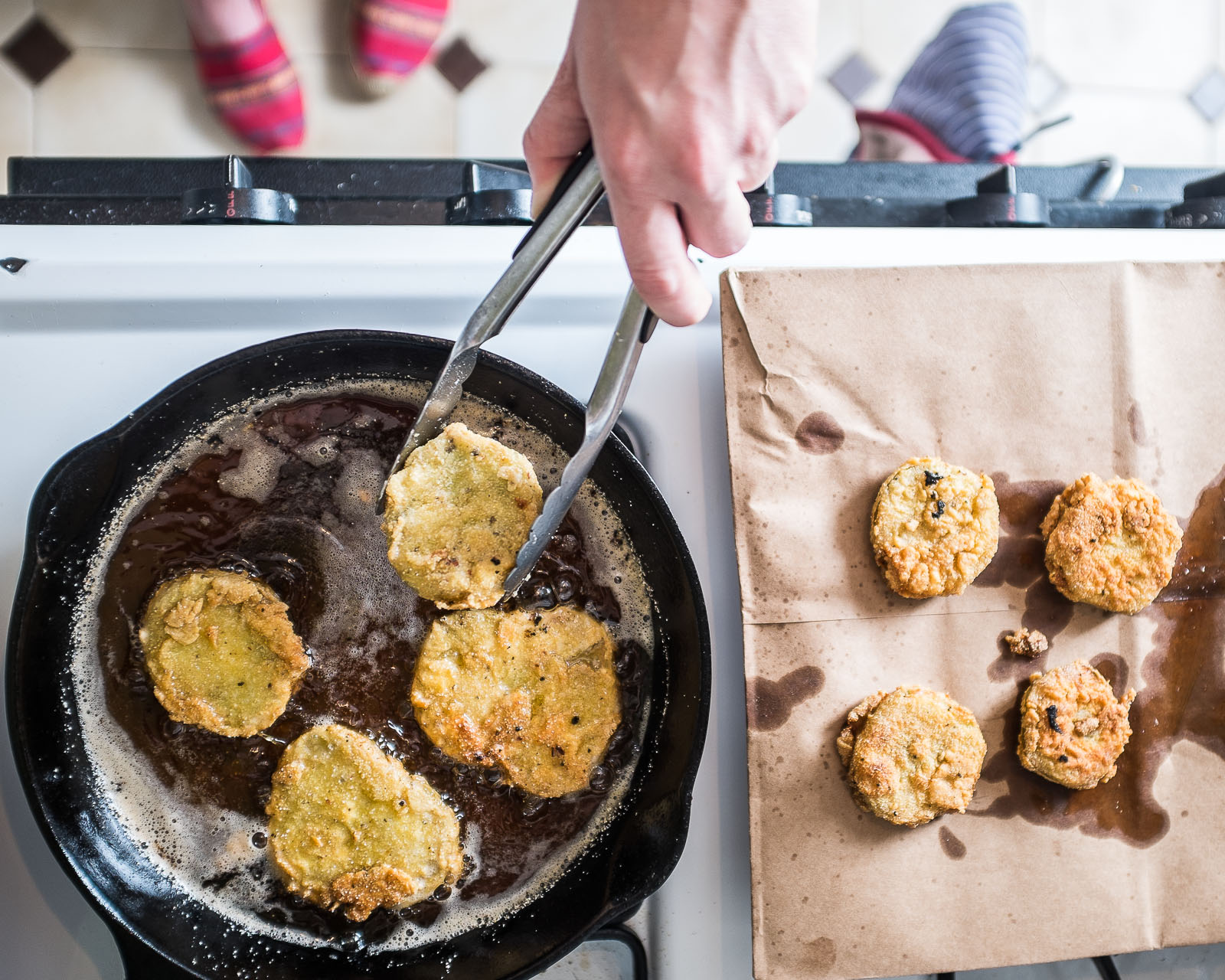
I settled on what I will call a Low Country Benedict: fried green tomatoes with Smithfield ham, poached eggs and a pimiento cheese hollandaise. Oddly, I have never made fried green tomatoes. And this summer my fecund garden is bursting with tomatoes – red, yellow, orange and green. When I think of eggs Benedict I think of the LA from the eighties, think LA Story and people lingering over coffee, mimosas and bloody marys and fancy, bougie French fare wearing sunglasses, white linen and big hats. That said, southern food is so, so, very, very en vogue here in LA (and everywhere) right now. Think Willie Jane and The Hart and the Hunter's entire menu, , A-Frame's fried chicken picnic, Son of a Gun's pimiento cheese with Ritz crackers, Lucques' annual rib-fest, everyone's deviled eggs, and so on. And perhaps most obviously, fried green tomatoes are, and have been for quite some time, very prominent in the south.

And so without further ado...


Fried Green Tomato Benedict with Smithfield Ham & Pimiento Cheese Hollandaise

Makes 4 servings

Ingredients

4 thin slices of Smithfield ham
2 tablespoons chopped chives, for garnish
4 eggs
2 teaspoons white or rice vinegar
4 large slices of fried green tomatoes
Salt & freshly cracked pepper

Pimiento Cheese Hollandaise

8 tablespoons (1 stick) unsalted butter
4 egg yolks
1 tablespoon lemon juice
4 teaspoons powdered cheddar cheese (found in your standard mac n' cheese package)
1 4 ounce jar of pimientos, chopped
Dash of cayenne or tabasco
Dash of Worcestershire sauce
Salt to taste


Directions

Start with the fried green tomatoes. Recipe below. Once they're cooked, keep them in the oven on warm until you're ready to assemble the dish.

Next bring a large saucepan two-thirds-filled with water to a boil, then add the vinegar. Bring the water to a boil again, then lower the heat to a bare simmer.

Make the pimiento cheese hollandaise. Vigorously whisk together egg yolks and lemon juice in a stainless steel bowl until the mixture is thickened and doubled in volume. Place the bowl over a saucepan containing barely simmering water (or use a double boiler); the water should not touch the bottom of the bowl. Continue to whisk rapidly. Be careful not to let the eggs get too hot or they will scramble. Slowly drizzle in the melted butter and continue to whisk until the sauce is thickened and doubled in volume. Remove from heat, whisk in powdered cheese a teaspoon at a time, Worcestershire sauce and cayenne. Stir in the pimientos. Cover and place in a warm spot until ready to use for the eggs Benedict. If the sauce gets too thick, whisk in a few drops of warm water before serving. Salt to taste

Poach the eggs. Here is  an easy method for poaching eggs. Essentially, working one egg at a time, crack an egg into a small bowl and slip into the barely simmering water. Once it begins to solidify, slip in another egg, until you have all four cooking. Turn off the heat, cover the pan, and let sit for 4 minutes. (Remember which egg went in first, you'll want to take it out first.) When it comes time to remove the eggs, gently lift out with a slotted spoon. Note that the timing is a little variable on the eggs, depending on the size of your pan, how much water, how many eggs, and how runny you like them. You might have to experiment a little with your set-up to figure out what you need to do to get the eggs exactly the way you like them.

Gently remove the eggs from the poaching water and set in a bowl. 

To assemble the eggs Benedict, put two fried green tomatoes on each plate and top each with a thin slice of Smithfield ham. You can trim the ham to fit the tomato if you’d like. Put a poached egg on top of the ham, pour hollandaise over. Top with sprinkles of chives and fresh cracked black pepper. Serve at once.


Fried Green Tomatoes

Ingredients

1  large egg, lightly beaten  
1/2 cup  buttermilk
1/2 cup  all-purpose flour, divided
1/2 cup  cornmeal
1 teaspoon  salt
1/2 teaspoon  pepper
1/4 teaspoon red pepper flakes
3  medium-size green tomatoes, cut into 1/3-inch slices
Vegetable oil
Bacon drippings
Salt to taste

Directions

Combine egg and buttermilk; set aside.

Combine 1/4 cup all-purpose flour, cornmeal, 1 teaspoon salt, red pepper flakes, and pepper in a shallow bowl or pan.
Dredge tomato slices in remaining 1/4 cup flour; dip in egg mixture, and dredge in cornmeal mixture.

Pour oil/bacon dripping to a depth of 1/4 to 1/2 inch in a large cast-iron skillet; heat to 375°. Drop tomatoes, in batches, into hot oil, and cook 2 minutes on each side or until golden. Drain on paper towels or a rack. Sprinkle hot tomatoes with salt.


One year ago: Anuradha Rice
Three years ago: Great Balls on Tires

Kamis, 13 Juni 2013

Blais Runner.


Chances are, you have probably heard of Richard Blais. Most likely from television. Most likely from reality television: Top Chef, Top Chef: All Stars, Life After Top Chef, Top Chef Masters, Iron Chef, and his own show on the Science Channel, Blais Off.

But here's why you should know Richard Blais: he received an AOS in culinary arts from The Culinary Institute of America and has studied under chefs Thomas Keller, Daniel Boulud, and Ferran Adrià. Blais also studied at Chez Panisse. He currently runs four restaurants, three in Atlanta: The Spence, Flip Burger Boutique (also one in Birmingham), and HD-1 (also known as Haute Doggery). In 2011 he released his cookbook, Try This atHome: Recipes from My Head to Your Plate. And, finally, he is slated to open another spot in San Diego in December.

It looks like he's also running marathons as well - Blais Runner (I had to do it). With a wife and two daughters, Blais is a busy man, to say the least.

So you can imagine my good fortune to be able to catch him for an interview recently to talk about the South, pimiento cheese, vinegar and his perfect picnic.


FFF:   I’m curious about how you got to Atlanta.

RB:   I’m a native New Yorker and I was dating a girl whose dad was a restaurateur in Atlanta. I was working in Manhattan at the time at Restaurant Danielle and the restaurateur asked me to come down there and take over the restaurant and I did.

FFF:  When was that?

RB:  That was a long time ago, 1999-2000.

FFF: I know that you’re not known necessarily for Southern anything, but I’m curious where you see the trajectory of Southern food and how you fit into that and what’s happening in the South, food-wise, right now.

RB:  It took me a while to really embrace Southern food as a stubborn Yankee, self-admittedly.  I think the thing about Southern food is that it is not a trend.  It’s all about heritage, ingredients and recipes.  There are a lot of young, modern chefs that are now bringing back heirloom seeds.  It’s never going to go out of style.  Southern cuisine happens to be the trend at the moment but it’s not molecular gastronomy or small plates - it’s history and tradition and it’s not going to go away.

FFF:  What do you think the great Southern food cities are right now?

RB:  A few I haven’t been to that I want to visit.  Certainly I think Charleston is a great food city.  Obviously, I’m a little biased to Atlanta - I think Atlanta is great.  I have not been but I need to get to Oxford, Mississippi.  I think that is a place that is just calling me, and I need to get out there. There are so many cities now.  It's not just about one place. There are great chefs and great restaurants in every city.

FFF: Any specific restaurants or chefs that come to mind?

RB: I'm a fan of all my colleagues and peers. I think Sean Brock (Husk in Charleston), who is a good friend of mine, is one of my favorite Southern chefs. He's from Richmond. I think Hugh Acheson is doing a great job. There are just so many. I mean certainly (Steven) Satterfield (Miller Union in Atlanta) and Anne Quatrano (Star Provisions), who I don't think a lot of people know. She is a chef in Atlanta and one of the best chefs in the country, if not the world. You don't hear her name a lot but she's been around.

FFF: I want to know what you're cooking/playing with right now that's seasonal or that's just weird and crazy that is really inspiring you.

RB: Herbs and flowers and the idea of what happens after we pick them: rosemary flowers or blossoms on other herbs. The whole seed to stalk thing. Cooking with the seeds as well as the stems as well as the blossoms. Herbs and flowers are what I'm into at the moment, but it changes every day.

FFF: I've been hearing a lot of buzz about Peru and ingredients sourced from the Andes. Do you think that is the next big thing? If not, what do you think is?

RB: It's funny you say that because I'm opening a restaurant in San Diego in December and my business partner and I are taking a trip to Mexico City and Peru. So, yes, I don't know if it's the next big thing, but people definitely want to know what's going on there.

FFF: I feel like right now the egg is the new bacon. I'm wondering, what is your ideal preparation of an egg, if you had to pick just one?

RB: It's not going to be as romantic as you would want. I like a good sunny side up egg, but cooked really hard on one side. So the bottom is crusty and all browned on the edges. I'm a native New Yorker, so Egg on a Roll style. I mean, who says roll anymore? No one says that except for my dad. But, yes, cooked hard on one side.

I think scrambled in a microwave probably would be my second. Using the microwave is pretty inspiring to me at home. People give it a bad knock, but it's usually the food that goes into it, not the technology itself.

FFF: You're on your way home in Atlanta traffic at about four o'clock in the afternoon and you get a call from your wife announcing that four of your friends are coming over for dinner in two hours. What are you going to do?

RB: Pasta. For sure. I'm on a big extruding pasta kick so we always have a number of shapes ready in our kitchen. Our kids are even making it. So I would say a pasta of some sort with some garlic, some vinegar, some fresh herbs and a little touch of butter.

FFF: Pimiento Cheese.

RB: Love it. I love it on a sandwich. I also love it on a cracker. As a matter of fact, I just did an event in Napa a couple of days ago where that was my dish. It was a big, fancy Napa Valley wine auction and I served it pretty much like a grilled cheese. I did a riff on it using Jack cheese and poblano peppers instead of pimientos, and a little bit of horseradish and chiles.

FFF: Duke's Mayonnaise?

RB: I love Dukes Mayonnaise! I'm a big fan of Duke's Mayonnaise. It's got more of an acidity to it. I like it on white bread, too. Soft, white bread... I'm a convert of the pimiento cheese sandwich and we eat it a lot. I even buy it sometimes, prepared from Whole Foods, and I have no shame in that. I also like it as a topping for a burger, a pimiento cheese burger.

It's such a simple thing, but most people don't know about it. It's got this sort of mystique to it, like it's a very famous French cheese. But it's just some chopped up cheese with some peppers and mayonnaise in it!

FFF: What is your ideal picnic and what is the one must-have that you are going to take on that picnic?

RB: Wow. Well, I'm not as much of an experienced picnic-er as I should be. Not to just recycle the last answer, but I would probably bring some pimiento cheese sandwiches. And some carbonated beverages – soda for myself, I'm a big soda freak. I actually do work with a soda company (DRY) as the creative director, which uses only four ingredients like natural sugar – so we're packing some cucumber soda for our picnic. And crudité! And, hey listen, leftover fried chicken is not a bad picnic thing. Some chili vinegar. I usually do a buttermilk-vinegar soaked chicken, a couple dredges of flour. Vinegar is my favorite ingredient in the world. That's the one. Vinegar makes food great. A lot of people think it's fat or salt, and those are important, but it's really acidity and vinegar.


And, so, as we have deemed June Picnic Month here at F for Food, we decided to make Richard Blais' 'ideal picnic':

Pimiento Jack Cheese Tea Sandwiches
Crudité: Radishes with Salted Butter and Heirloom Tomato, Cucumber, Red Onion Salad
Cucumber Soda
Double-Dipped Buttermilk-Chile Vinegar Marinated Fried Chicken
Chocolate Chunks

Everything was sensational. I even like his version of pimiento cheese (I can feel my mom's eyes rolling out of her head right now). I think Blais would be pleased - we used vinegar in almost everything. I even made my own chile infused vinegar for the salad dressing and the chicken marinade. But the recipe I want to share is that of the fried chicken. That was the star. The chile vinegar added a really nice back end heat with every bite, and the double dredging ensures a super, extra awesome crackly, crispety, crunchety skin. And that's the whole point, right?

Happy picnicking!


Double-Dipped Buttermilk & Chile Vinegar Fried Chicken

Serves 4

2 cups buttermilk
3 tablespoons chile vinegar
1 tablespoon dijon mustard
2 teaspoons tarragon, divided
½ teaspoon paprika
1 teaspoon plus ½ teaspoon cayenne pepper
1tablepoon plus 1 teaspoon salt
1 tablespoon plus 1teaspoon ground pepper
1 chicken cut up into 8 pieces
3 cups all-purpose flour
Vegetable shortening & vegetable oil, for frying


Combine the buttermilk, chile vinegar, dijon mustard, 1 teaspoon tarragon, paprika, ½ teaspoon cayenne pepper, 1 tablespoon of the salt, and 1 of the pepper in a nonreactive bowl large enough to contain all of the chicken pieces with at least 1 inch to spare. Add the chicken and turn to coat fully in the marinade. Cover with plastic wrap and marinate in the refrigerator for at least 6 hours or overnight. Remove the chicken from the refrigerator about 45 minutes before frying.

Line a large baking sheet with aluminum foil. In a large, shallow bowl, combine the flour, remaining salt, pepper, tarragon & cayenne pepper. Remove the chicken from the buttermilk marinade and roll it around in the seasoned flour until completely covered. Set it on the prepared baking sheet; repeat with the remaining chicken. Dip the coated chicken pieces once more in the marinade, then again in flour. Return the pieces to the baking sheet (a few minutes’ rest makes for a sturdier, crisper coating).

Have a wire cooling rack set over paper towels ready. In a large, heavy cast-iron skillet, heat 1 1/2 inches of shortening & oil over medium heat until it reaches 350°F on a deep-fat thermometer. Using kitchen tongs, add a few chicken pieces at a time to the hot oil (crowding will lower the temperature, making for greasy chicken). Fry the chicken until the internal temperature reaches 180°F, about 10 minutes per side (watch carefully, it can easily burn). Transfer the cooked chicken to the wire rack. Serve immediately or at room temperature (don’t let the chicken sit more than 2 hours).

Do it Early
The chicken can be fried up to 2 days in advance, covered, and refrigerated. Serve it cold—a classic picnic food—or reheat on wire racks set on baking sheets in a 375°F oven for 15 to 20 minutes.

Tip 
If the chicken looks pretty dark before it is cooked through, transfer to wire racks set on baking sheets and bake in a 375°F oven until the meat reaches an internal temperature of 180°F on an instant-read thermometer. Keep fried chicken warm in a 200°F oven. Using a digital thermometer eliminates the need to stand over the chicken. When the alarm sounds, the meat is done.


Three years ago: Shiso Leaf Butter

Kamis, 04 April 2013

Crispy Skin Bone-in Pork Belly by Bill Granger


here you are...as promised ...

the 3 to 4 hour PORK BELLY

if you've been following along you probably read about the delicious 3 DAY Pork Belly.  well, this one takes about 3-4 HOURS and it's just as pork-belly-icious!.  
i always say...
"you can't go wrong with pork belly".

this technique produces the ultimate crispy crunchy skin and...
juicy fat dripping tender pork belly.


two things that i had never tried before... cooking a pork belly with the bone in and cooking skin side down for the first few hours. 
for some reason it's a little more expensive with the bone, but that's only about $3.59 a pound.  more money = more delicious?...not a big difference, but the meat next to the bones and the ribs i ate immediately were fall-off-the-bone delicious.
after it was all finished, i removed the bones with a long sharp knife very close to the bones so that slicing the pork belly in serving portions would be much easier.  on Bill's show he was able to slice each portion with bone still attached which made for a nice plate presentation.   his servings looked like unctuous pork chops with belly fat and skin attached, if that makes sense.
the Caramel Vinegar Glaze is delicious as well.  i did not finish the glaze until late night so it didn't make the photo, but do try it.  i think it would go well with just about any pork dish...or chicken.

AND...as far as the skin side down results?... i'm pretty sure i will do it this way from now on...the skin was perfect !!!...extra crispy.


CRISPY SKIN BONE-IN PORK BELLY
with CARAMEL VINEGAR GLAZE
by Bill Granger

3 1/2 lb pork belly with bones
2 Tbsp kosher salt, plus more as needed
extra virgin olive oil, as needed
fresh ground black pepper

score the skin of the pork belly in criss-cross pattern as shown.  rub the salt into the skin and set aside for 30 minutes

preheat oven to 425 degrees.

wipe the salt off of the skin and dry well with a paper towel.  drizzle a large roasting pan with olive oil. as you can see, i lined the pan with tin foil for easier clean up...BAD IDEA.  the skin stuck in some areas where the oil did not meet the skin.  note to self...go for bare naked and deal with the clean up later, it's not all that bad.  anyway...place the pork skin side down on the roasting dish and season the top with salt and pepper and a drizzle of olive oil.  put in the oven for 30 minutes to sear the skin.  then  reduce the heat to 375F degrees.  continue cooking for another 1 1/2 to 2 (mine was in for about 2 1/2 hours), or until fork tender.  now remove from oven and carefully flip over so it is skin side up.  roast for another 30 minutes or until skin is good and crispy.  you might choose to use the broiler for a moment watching carefully!
remove the pork belly from the oven and let rest for at least 15-20 minutes.

the roast is easiest to cut with the skin side down on the board.  my bones were going the length of the pork belly so i removed them close to the bone.  (NOTE...the meat next to the bone is the chef's secret treasure bites). if your bones are going the width, you can slice a serving with bone attached for plating presentation and maximum enjoyment.

CARAMEL VINEGAR GLAZE
(not shown, but delicious)

1/2 cup brown sugar
1/3 cup red wine vinegar
2 star anise
1 cinnamon stick
1 cup good chicken stock
juice from 1 orange,  plus 4 wide strips of orange peel
sea salt and fresh ground pepper

put the sugar, vinegar, star anise and cinnamon in a small sauce pan and cook, stirring over medium heat until the sugar has dissolved.  bring to a boil and simmer for about 5-10 minutes or until mixture is syrupy.  stir in chicken stock and simmer until slightly reduced.  add the orange juice and peel, reduce the hat to a low simmer until the mixture is thick and syrupy.  don't forget to season with salt and pepper when just about done.
NOTE...this took longer than expected.  give yourself 30-45 minutes for a nice syrupy glaze.

above is example of scoring.  my new favorite tool for the job is a razor sharp box cutter.
 above is before oven using tinfoil...bad idea.  don't use tinfoil... and below is after roasting with skin side down.  it should be fork tender at this point.  then it goes in skin side up for the final crisping of the skin.

Senin, 11 Maret 2013

Building a Fort


There has been a lot of stuff going on in the world of Fred and me. We are great, don't you worry. But the world around us has been a bit, shall we say, dicey. We have both been moving very fast, doing a lot of things, a lot of busy. Yet we have been ships in the night, hardly had a moment to really spend quality time with one another. In our house, the books and magazines have been piling up to resemble colorful totem poles, the garden is more like a graveyard, and as of last Friday, you could hear an echo in our refrigerator.

And so we decided to STOP. We decided to spend our weekend together, focused on the things we love to do together and the things we love about each other. We decided we were going to shut off the world, and concentrate on what home means to us. We decided to have vacation. Go camping. At home.

On Friday, while Fred was at work, I took off and stocked up on all of the provisions. Groceries, firewood, dog bones, you know, the usual stuff. Once I got home and put all of the groceries away (one of my very favorite things to do), I did laundry, so all of our cozies were clean and warm, cleaned the house and set some of our favorite old movies to record (and a Lakers game for Sunday). I then called Fred and told him we were ready: the house was clean and sparkly, and the kitchen stocked. Let the staycation commence.

Once Fred got home, we both changed into our cozies, put on some Otis Redding and poked and prodded about our stocked-for-the-apocalypse kitchen for a guiding light. Parsnips, savory, carrots, burrata, walnuts, blood oranges, Littleneck clams, duck breasts, Anson Mills grits, rapini, hominy, salted capers, bacon, okra(!), leeks, pasilla pepper, Pacific cod, a whole chicken, potatoes, fresh cream, and more – I was paralyzed with options. So I turned to Fred and asked him to just pick a protein, and I would run with it from there. Clams.

I can do that.

While in Inverness recently, we stopped at a little spot on Tomales Bay and had a bowl of clam chowder. It inspired me, which is why I had purchased the clams in the first place. I liked this direction. And as Fred built a fire in the fireplace, my plan evolved even more. On that brisk, drizzly evening, while in our cozies, we decided to cook the soup on the open fire. We were camping, after all.

And so we brought all of our provisions, our mise en place, into the living room, dimmed the lights and lit candles. And as Otis crooned in our ears, and the fire warmed our faces, and the dogs curled up close to us with their bones, I got started steaming the clams while Fred chopped potatoes, celery, onions and garlic on the cutting board by the hearth.

Though, admittedly, it was a challenge for the OCD part of me to relinquish control of the mess that was inevitable for this indoor camping night to be successful, it was so, so beautiful. So warm and intimate, so still. As we slurped our steamy chowder and messily brought dunked, torn chunks of baguette, dripping with creamy stew and pieces of potato and clam up to our faces, we hardly said a word. Instead we stared around the room, at the pups, at the fire, at each other, and smiled and giggled.

When we were full of clam chowder and bread, we left everything as it was. As the fire continued to flicker, and the music played on, we stayed and languished on the floor and did the crossword until the light was completely gone, but our smiles remained.

Sometimes it's important to close the door to the rest of the world and take stock on what's really important; love, warmth, smiles, giggles, and home – wherever you make it.


Classic New England Clam Chowder

Serves 6-8

Ingredients

4 pounds cherrystone clams, scrubbed
1/2 cup vermouth
1 tablespoon unsalted butter
4 ounces bacon, cut into 1/2-inch pieces
1 celery stalk, diced
1 large onion, diced
1 garlic clove, minced
1 Yukon Gold potato, peeled, cut into 1/2-inch pieces
1/2 tablespoon chopped fresh thyme
1 bay leaf
1 tablespoon cornstarch
1 cup heavy cream
Kosher salt, freshly ground pepper
Chopped fresh chives
Oyster crackers or Fresh Baguette

Directions

Bring clams, vermouth and 2 cups water to a boil in a large pot over high heat. Cook until clams just open, 8-10 minutes (discard any that do not open). Using a large slotted spoon, transfer clams to a large rimmed baking sheet; set broth aside. Let clams cool slightly, then pull meat from shells; discard shells.

Chop clams into bite-size pieces. Strain broth through a fine-mesh sieve set over a large bowl. Add water if needed to measure 4 cups. 

DO AHEAD Clams and broth can be made 1 day ahead. Cover separately and chill.

Melt butter in a large heavy pot over medium heat. Add bacon and cook, stirring occasionally, until fat is rendered and bacon begins to brown, about 8 minutes. Add celery, onion, and garlic and cook, stirring often, until onion is translucent, about 10 minutes. 

Add reserved broth (or 6 cups bottled clam juice), potatoes, thyme, and bay leaf. Bring chowder base to a simmer; cook until potatoes are tender, 20-25 minutes. 

Stir cornstarch and 2 tablespoons water in a small bowl to form a slurry. Stir slurry into chowder base; return to a boil to thicken. 

DO AHEAD Base can be made 1 day ahead. Let cool; cover and chill. Keep clams chilled. Bring base to a simmer before continuing.

Remove base from heat. Discard bay leaf. Stir in reserved clams and cream. Season with salt, if needed (clams' brininess varies), and pepper.

Divide chowder among bowls. Garnish with chives, and serve with bread or crackers.


Rabu, 27 Februari 2013

Comfort Me With Bucatini.


Growing up in Richmond, I recall very little pasta happening in either of my parents' kitchens, except maybe pasta salad. I also don't remember going out for much Italian food back then. I'm sure there was spaghetti and meatballs when I had dinner at my friends' houses, but – and I could be wrong – I don't think I ever saw it on my dining room table(s). That's weird, right? I mean, I don't even think we did lasagna, for crying out loud. It's a miracle I turned out alright.

That being said, there wasn't a ton of Italian food in my life for quite some time. After college, in the early Atlanta years, there were a couple of EYEtalian restaurants where I dined on occasion. By EYEtalian, I mean dimly lit rooms with red checker tablecloths, taper candles in old chianti bottles, dishes like eggplant parmigiana, veal scaloppini, chicken marsala, penne alla vodka (one of my favorite pasta dishes to this day), mostaccioli, linguine with clam sauce, baked ziti, lasagna, and spumoni or cannoli for dessert. Oh, and both kinds of wine: red and white.

Then in the last year or two there, a couple of Italian restaurants popped up that became game changers. For me, at least. Actually, it was really one restaurant that later became two with the same owner. The first born, Sotto Sotto, was the higher end version of its younger sibling, Fritti. It was at Sotto Sotto where a lot of things about Italian fare really evolved in my world. In a little restaurant in Inman Park, Atlanta, my palate got to travel from Southern to Northern Italy for the first time. I remember tasting delicate, handmade pastas of all shapes, sizes and consistencies, flecked with bright and fresh surprising accents like arugula, mint, and lemon or anchored down with braised, local duck with an aged twelve year balsamic. There were fresh truffles, walnut sauce and sage browned butter, which fifteen years ago was not something I saw on menus very often. I remember having the most delicate beef carpaccio I had ever tasted. The beef sliced so carefully, so thinly, that it essentially melted on my tongue. And then when the little sister, Fritti, came along, I was introduced to the lightest, freshest calamari fritti, garnished only with fresh lemon, and their crimini and portobello mushrooms, lightly fried in rice flour batter with white truffle oil. Most importantly, it was the first time I became acquainted with Neapolitan pizza. And burrata.

Best of all, I lived a mere two blocks away. Even bester, two of my girlfriends and my then boyfriend worked there.

And so an Italian food lover was born.

In the eleven years that I have lived here in LA, though, I don't make pasta at home as much as other things, I would say that my go to meal out is easily for Italian food. More often than not, what I crave is the Northern Italian fare; the fine handmade pastas with fresh, seasonal produce, nuanced flavors and elegant sauces, and almost always I will opt for Neapolitan pies to that of any other. That said, I would never turn down a dinner at Dan Tana's. Who wouldn't want a side of spaghetti with their spaghetti?


But here's the thing, a couple of years ago I came across a recipe in The Week for a dish called Cacio e Pepe. Its scant few ingredients and seemingly whimsical and simple process tempted me. The recipe called for a long pasta (in this case, bucatini), Parmesan cheese, extra virgin olive oil, Kosher salt and lots and lots of freshly cracked black pepper. After I tried to make it the first time, and failed, I started to read about the recipe. I realized that this dish exemplifies the complexity of pan sauce precision. Of course! This is one of those less-is-more, minimalist recipes by which cooks are measured – and as I read on, I learned that no two chefs agree on how to do it just right.

And, it's a Roman dish... making it kind of EYEtalian!

After that, my interest was piqued. If I saw it on a menu, I ordered it. And, for the most part, folks were using the bucatini. So, my only occasion, other than my own kitchen defeat, for both the bucatini and the cacio e pepe had been when dining out.

Then I met Fred. And on our third date, he invited me to his place to cook me dinner. I remember thinking, “Uh, oh. He has no idea what he's gotten himself into. Be nice, be nice, be nice.” Beyond all of the bells, whistles (the right kind, not the gaudy kind), and the ts crossed and is dotted, there he was, in his kitchen, with a YouTube video playing on his iPad illustrating how to make cacio e pepe. And before you ask, no, he had no idea. This was all Fred.

I remember thinking it was going to be a disaster. If I couldn't make it right, and it was such a cornerstone for great chefs, how was hegoing to do it?

It was perfect. It is still the best version of cacio e pepe (and with bucatini, mind you) I have had to date. I'm serious!

And so, not only did cacio e pepe become even more pivotal to me, but bucatini, in particular did as well. Unfortunately, I have only stumbled upon it a few times here in LA since I began this obsession. And I look. Once I saw it at the Silverlake Farmers' Market, but it seemed a little pricey. Anyway, on a recent trip to San Francisco, Fred and I poked into our favorite EYEtalian deli and grabbed every kind of bucatini they had. That would be five (5) different brands of bucatini.

And a couple of nights ago I made a dish with the prettiest and fanciest of our bucatinis. It was a type of a cacio e pepe, but I added shaved asparagus stalks, a single clove of garlic, some red pepper flakes, lemon and I topped everything with fresh breadcrumbs. I also used two cheeses; a Grana Padano, for its velvety texture, and Pecorino, for its sharpness. Other than adding the extras, the concept and the technique were no different than the original cacio e pepe.

I'd like to tell you how romantic it was that we made this, our very special dish together. I'd like it to seem like we savored that last strand of bucatini like the Lady and the Tramp. But we were really just so excited and so hungry, that we pretty much inhaled our big bowls of pasta and glasses of chianti. Just-a like-a Mama would-a like-a.


Bucatini with Shaved Asparagus & Fresh Breadcrumbs
Serves 4


Ingredients:
2 thick slices hearty bread, torn into about 1-inch pieces

extra virgin olive oil

1 pound bucatini

red pepper flakes

1 clove garlic, minced

2 bundles asparagus, shaved

The juice of 1 lemon

1/4 cup mixed grated Grana Padano & Pecorino cheeses
Kosher salt, and freshly cracked black pepper


Directions:
Preheat oven to 400 degrees.  Pulse bread in food processor to make bread crumbs.  Spread the crumbs on a small baking tray.  Drizzle with olive oil and a pinch of salt; toss.  Toast for 15 minutes, or until golden brown.
Meanwhile, bring a large pot of salted water to a boil.  Cook bucatini until al dente.  Reserve a bit of the cooking water.
Just before the pasta finishes cooking, heat about a tablespoon of olive oil in a skillet.  Add garlic and a pinch or two of red pepper flakes and cook until fragrant, about a minute.  Add asparagus and a pinch of salt; cook until the asparagus until slightly softened.  Add juice of the lemon.  Toss.
Add the cooked bucatini and parmesan to the skillet with the asparagus; toss to coat.  Add reserved cooking water a tablespoon at a time, if necessary, to achieve your desired consistency.  Serve, topped with toasted breadcrumbs.


Printable recipe.

One year ago: Grilled Oysters with Garlicky, Lemony, Buttery Sauce
Two years ago: I Left My Heart in San Fran-cheesy; Part 3, The Final Chapter
Three years ago: Chili with Beef & Bacon
Five years ago: Angelini Osteria