Search

Tampilkan postingan dengan label mint. Tampilkan semua postingan

Selasa, 02 April 2013

Consider the Waffle.


While ambling through a thrift store recently, I stumbled across a waffle iron touting itself as The Belgian Waffler. It gave me pause. Though I couldn't remember the last time I ordered a waffle from a menu, I knew for certain that, other than putting a frozen one into a toaster in or around the second grade, I had definitely had never made one. The colors and the font on the circa 1982 Belgian Waffler box reminded me, fondly, of Busch Gardens, an old-world European theme park back in Williamsburg, Virginia. The Old Country, as it was tagged, featured a number of 'hamlets' like Oktoberfest (Bavarian Germany), Killarney (Ireland), Heatherdowns (Scotland), Aquitaine (France) and Banbury Cross (England) to name a few, all with appropriately themed food, games and rides. For you Californians, if Solvang had skee ball and roller coasters, it would be a dead ringer for a hamlet in Busch Gardens.

And so, for a mere four dollars and ninety-nine cents, how could I not purchase this novelty kitchen tool that elicited so much nostalgia?


As I unpacked the day's treasures; two vintage pea green and ecru plates and a matching creamer made of genuine English china (must have been part of someone's wedding gift at some point), one ornate soup spoon, one floral Asian rice bowl and an old, wonky muted blue and white dish that I deemed a perfect pasta bowl, I stopped and stared at The Belgian Waffler. Once I got past another Busch Gardens flashback of taking the gondola lift from Banbury Cross to get to the Le Scoot Log Flume and then the steam train to get to Heatherdowns to ride the Loch Ness Monster, I contemplated the actual waffle iron and wondered:

What's the story with waffles? Who eats them? Who makes them at home? I think I miss Eggos. Should I go get some? I bet two of those would make great bread for a sandwich.

After some sleuthing I came across an article in Time magazine from November of 1999, covering the flooded Tennessee Kellogg plant that forced the company to ration its supplies for over six months. Apparently the shortage was called a “national calamity, further proof of global warming's reach, a sign of the apocalypse, evidence of a corporate conspiracy and a good opportunity to cash in.” (Witness the Katy, Texas, resident who posted a "rationed" box of Blueberry Eggos on eBay — "toaster not included.")

I guess we like our waffles.

I was not more than a little bit surprised to find the waffle's origin traced back to none other than ancient Greece. The original waffles were basically communion wafers called oublies made with grain flour and water, pressed between little irons embossed with Biblical scenes or allegorical designs.

From there, the waffle's journey is an interesting one. One of my personal favorite highlights of its trajectory involves a 16th century painting that not only shows waffles being cooked, but also features a man wearing three waffles strapped to his head, playing dice for waffles with a black-masked carnival-goer.

Detail from Pieter Bruegel's Het gevecht tussen Carnaval en Vasten - among the first known images of waffles.

In the 17thcentury sugar was so prohibitively expensive that waffles were pretty much reserved for only the fancies. And, finally, around the 18thcentury the word waffle first appeared in the English language and the recipe could be found in American, English, Dutch, Belgian, German and French versions. Rumor has it Thomas Jefferson even had waffle parties. Wild Man Jefferson, they must have called him.

By the early 20thcentury ye olde waffle craftsmen were diminishing and the waffle became something people primarily made at home. This decline was accelerated by the invention of the first electric waffle maker (GE), waffle mixes by the likes of Aunt Jemima and Bisquick and, of course, that wacky trio of brothers, the Dosas, who provided us with our favorite frozen specialty, the Eggo waffle. Bringing us back to me standing in the thrift store, thinking about putting a waffle in the toaster oven in or around the second grade.

Upon my research, I was pretty excited to learn that some of the very earliest French waffle recipes, dating back to the late 14th century, were savory ones; “Beat some eggs in a bowl, season with salt and add wine. Toss in some flour, and mix. Then fill, little by little, two irons at a time with as much of the paste as a slice of cheese is large. Then close the iron and cook both sides. If the dough does not detach easily from the iron, coat it first with a piece of cloth that has been soaked in oil or grease.” Some other variations explain how cheese is to be placed in between two layers of batter, or grated and mixed in to the batter. Wine? Cheese? Sounds right up my alley.

For my fist experience with The Belgian Waffler, I was going to use one of the recipes on the back of the box. But then I thought to check in on my all-time favorite breakfast maker, Marion Cunningham, for her advice. She has never, ever done me wrong. Not when I need to make biscuits, or granola, or muffins, or breakfast breads, or pancakes, or even pancakes with fruit. Never.


Plus, my logic reminded me that in the eye of the frozen waffle storm sweeping this country, in or around when I was in the second grade, was also exactly when Marion Cunningham actually took the time to make her family waffles for breakfast. Even more precious, in her description above the recipe she goes so far as to explain that this is “ideal for spur-of-the-moment breakfast when you haven't time for yeast-risen waffles”. I mean, come on. Often mornings for me in or around the second grade involved my dad gulping exactly a cup and a half of coffee (half decaf, half caf) while watching The Today Show, and then standing by the front door, impatiently, with a banana in hand as I was grabbing my waffle out of the toaster, smearing butter on it, wrapping it up in a paper towel so I could catch a ride to school. But only as far as his work, mind you. I walked the rest of the way eating my breakfast. Yeast-risen waffles, yeah right, Marion.

So, yes, I went with Marion's classic waffle recipe but I added a little health. A little now. I added some chia seeds and some flax seeds.

And as Fred prepared macerated blackberries with fresh mint to go on top, I began to heat up The Belgian Waffler for its maiden (at least in this decade, I would imagine) waffle voyage.

Though it's clearly been a very, very long time since I've had a meal of waffles, and I rarely opt for the sweet breakfast over the savory, I enjoyed this one immensely. The waffles were steamy warm, crisped light brown on the exterior, and substantial but moist inside. And they were only as sweet as what you put on top of them. I went for heavy on the butter and light on the maple syrup. We had the good stuff a neighbor brought back from Vermont. I enjoyed the texture and also the look that the seeds added. Fred piled his high with the sweetened berries and mint, in addition to the syrup. We cleaned our plates and then bickered over the last square.

There will be more waffles. I will make the recipes on the back of the box. But mostly, I keep thinking about using two waffle squares as sandwich bread...
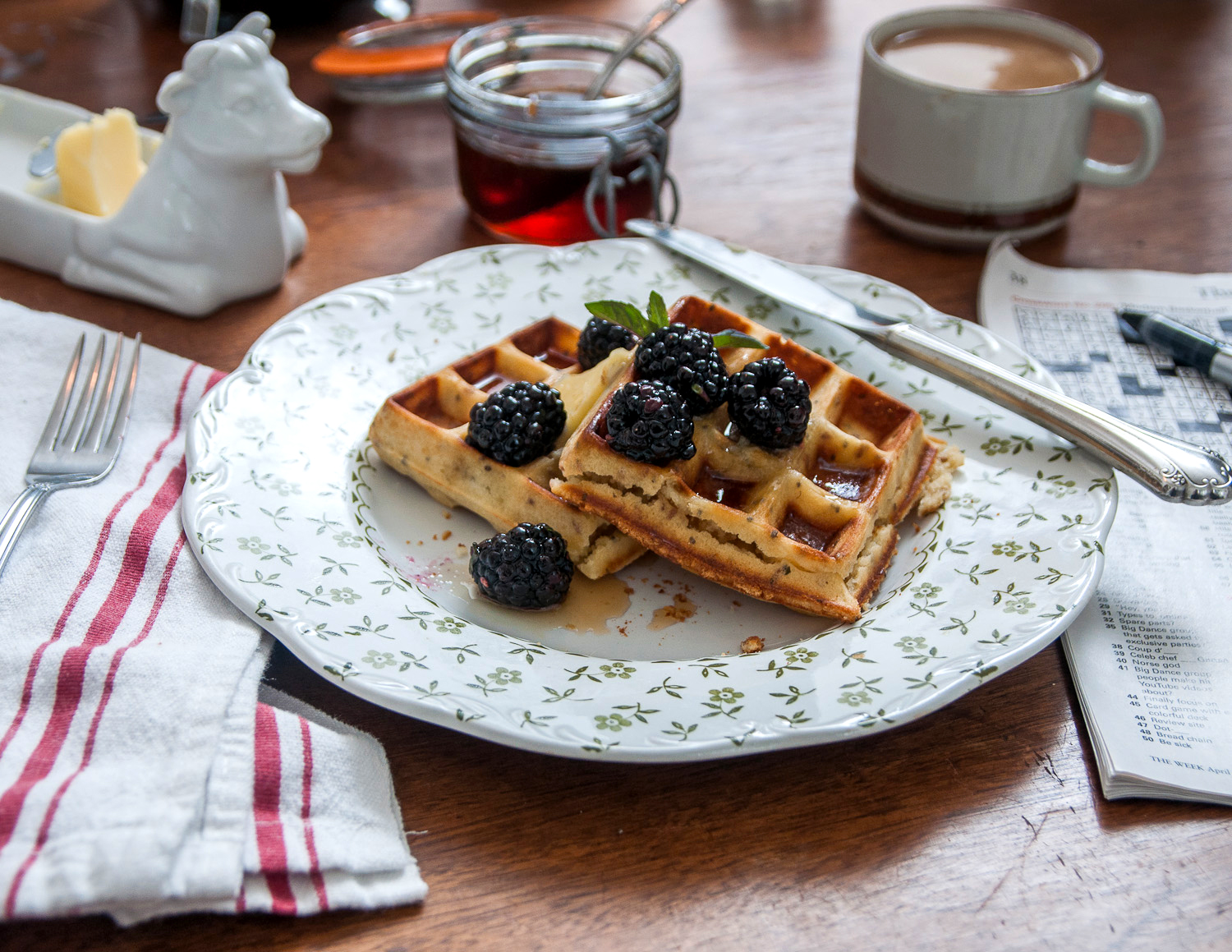

Chia & Flax Seed Waffles with Blackberries & Fresh Mint

Waffles

Makes about 8 waffles

2 cups all-purpose flour
1 teaspoon salt
4 teaspoons baking powder
2 tablespoons sugar
2 eggs, room temperature
1 1/2 cups whole milk, warmed slightly
1/3 cup vegetable shortening, melted
1/3 cup (2/3 stick) unsalted butter, melted
1 tablespoon chia seeds
1 tablespoon flax seeds

Put the flour, salt, baking powder, and sugar in a mixing bowl and stir the mixture with a fork until blended.

In another bowl, beat the eggs well and stir in the milk. Combine with the flour mixture until mixed. Add the melted shortening and butter and beat until blended.

Blend in chia and flax seeds.

Pour about 3/4 cup batter into a very hot waffle iron. Bake the waffles until they are golden and crisp. Serve hot & top with macerated berries, butter & maple syrup. Or whatever you want.


Macerated Blackberries

2 cups fresh blackberries
1 tablespoon plus 2 teaspoons sugar
1 teaspoon shredded fresh mint

Combine blackberries, sugar, and mint. Refrigerate for 1 hour.


Three years ago: Potato Fennel Hash

Selasa, 26 Maret 2013

Out Like a Lamb.


The end of March is nigh, and thus is Easter. Passover is happening right now. It's a big time for a lot of people. And plants. Plants are having a blast right now. And people are having a blast with plants. Or, at least, Fred and I are.

When we last spoke, I had mentioned having chatted around to get a feel as to what food things meant to people with regard to Easter. I ended up settling on chocolate and lamb, though not necessarily together – which might not be a bad idea, come to think of it. So I shared a chocolate recipe.

So you probably know where we will be going with this. Lambville.

Coming from completely non-religious parents, other than the Easter Bunny covertly surprising me with an Easter basket each year at my mom's house, Easter meant little else. I don't even recall a special meal. So after sifting through people's responses to my query about what Easter represented, culinarily, to them, I went about figuring out what it meant to me. And I decided to embark on the most traditional Easter supper I have ever had. First order on the agenda: order a giant leg of lamb.


I like lamb just fine, now, but as a child it unnerved me a little. I think it was just the gamey-ness of the meat. It wasn't on the dinner table too often at home, but I know Dad loved it. He always ordered it at the Greek restaurant in our neighborhood. He loved their Lamb Guvetsi.

As I mentioned, years ago, like 2005, I heard Nigella Lawson interviewedon NPR around this time of year. She was promoting her then new book, Feast, a cookbook devoted primarily to celebrations, holidays and entertaining. I vividly recall her discussing her favorite Easter meal, and the great detail with which she described a saffron roasted leg of lamb and some sticky, crispy garlic potatoes. Obviously it stuck with me if eight years later that was the first thing to pop into my head when I decided to make my first, big Easter dinner. So I started planning the menu, the flowers, the dining room look, and called some friends.

Easter dinner was so happening.

Two days before the event I put the lamb in its marinade and refrigerated it. The day before, while Fred went out to get all of our groceries, flowers and the like, I poked around on the computer to find out why lamb in the Spring, and why lamb on Easter. Why throughout the entire world the most popular Easter symbol is the lamb. I'm sure, as usual in this department, everyone else already knows this stuff, but I'm new here.

The roast lamb dinner that many eat on Easter Sunday goes back earlier than Easter to the first Passover of the Jewish people. The sacrificial lamb was roasted and eaten, together with unleavened bread and bitter herbs (a Seder) in hopes that the angel of God would pass over their homes and bring no harm. As Hebrews converted to Christianity, they naturally brought along their traditions with them. The Christians often refer to Jesus as The Lamb of God. Thus, the traditions merged.

In the 7th century the Benedictine monks wrote a prayer for the blessing of lambs.
A few hundred years later the pope adopted it and a whole roasted lamb became the feature of the Pope's Easter Dinner, and has been ever since.

I wasn't going to roast a whole lamb, of course. Just one of its legs.


Now this lamb recipe involved saffron, which I absolutely love. I know a lot of people do not, however. It seems to be one of those ingredients like cilantro: people either love it or hate it. And I understand. Also, like cilantro, it has an unmistakable, very distinct aroma and taste. The thin, delicate, muted red hair-like strands are fragrant, floral, earthy, and honey-like with a bit of bitterness. Saffron also happens to be the most expensive spice in the world. Use too much and that will be the only thing you take away from that dish. With saffron, the words 'a little goes a long way' have never been more accurate. A little dab will do ya.

It's no surprise that you will find a wealth of recipes with saffron and lamb together. Kind of like chocolate and peanut butter, they just make sense. They are also both prominent elements in a lot of Middle-Eastern cuisine. Actually, it's funny, lamb takes me back to eating Greek food with my dad, and I used Greek saffron with my Easter lamb.


Yesterday, on the event of my Easter dinner celebration, once the lamb went into the oven after two days of marinating, I went about the décor of the dining room. I hand-picked each and every piece of silverware, plate and glass, dug through the linens to find the right napkins – I went for the fancies – and began meticulously arranging the bundles of daffodils and hyancinths into little vintage creamers and jelly jars while listening to my go-to soothing sounds: Explosions in the Sky. All the while the house was filling up with the entrancing smell of lamb, lemon and garlic fusing together in the oven. I dare say it was beginning to smell like Easter. Or, at least, really, really good. The air smelled like family and friends and the promise of festivity and future fond memories.

Everything was coming together perfectly. The food was on schedule, the room looked great, I had the perfect wines; some lovely rosés from a tasting the day before, and just moments before the guests arrived, as I was lighting the candles, Fred and I got our Easter baskets in the mail! I guess the Easter Bunny is trying to help out the US Post Office in their time of need... Nevertheless, that took care of dessert; Cadbury Creme Eggs!

As we all sat down to the table, we raised our glasses of rosé and toasted to a happy Easter. And as I looked around the room, I took stock. The smiling faces of my friends, the table looked beauteous, the food was delicious, the wine went perfectly with the saffrony lamb, the flowers smelled wonderful, and best of all we were all so happy to be with each other. Good friends, together, on our Easter, eating, drinking, smiling, talking, sharing Easter memories and laughter.

SAFFRON ROAST LAMB WITH STICKY GARLIC POTATOES
(recipe adapted from Nigella Lawson's book, Feast)

Serves 6
1 leg of lamb (4.5 lbs)
1/3 cup olive oil
3 cloves garlic, bruised
6 scallions
2 bay leaves
juice of 1 lemon
small bunch mint, 1 1/2 oz including stalks, torn roughly makes 1 cup
1/2 teaspoon saffron threads, steeped in 1 cup very hot water
1/3 cup rosé wine

 Put the lamb in a large freezer bag, pour over the olive oil and then throw in the garlic, trimmed scallions and bay leaves, squeeze in the lemon juice and throw in the squeezed-out lemon halves too, then add the torn-up bunch of mint. Seal the bag and marinate in the fridge overnight.
Bring the lamb to room temperature before you even think of putting it in the oven, and preheat that to 425 degrees F when you take the lamb out of the fridge.
Pour the entire contents of the freezer bag into a roasting pan and roast for about 20 minutes a pound, or until the lamb is cooked a perfect, à point pink; you will just have to pierce it with the knife to see. Just before the lamb is due to come out of the oven, put the saffron strands in a measuring cup and pour over the hot water so that it can get on with steeping.
Remove the lamb to a wooden carving board to rest. Pick out the lemon rinds, and then place the roasting pan on the stove over medium heat, and stir until it starts bubbling. Stir in the saffron in its water and add 1/3 cup rosé – tasting for seasoning as you go – as needed to let this bubble into a small amount of ungloopy gravy. 
Carve the lamb on to a large warmed plate and strain the saffrony juices, stirring in any liquid first from the carving board, over the pink meat.
Read the sticky garlic potato recipe now so that you can coordinate your movements. And, to go with, I'd want no more than a bowl of green peas, turned in some butter.

STICKY GARLIC POTATOES
Serves 6
1 1/2 lbs small fingerling potatoes
8 cloves garlic (more if you like)
1/2 cup olive or other vegetable oil 
Coarse salt & freshly cracked pepper to taste.

Bring a saucepan of water to the boil and add some salt, add the potatoes and cook for 30 minutes. Drain, and put back into the dry pan.


Peel the garlic cloves by squishing with the flat of a knife so that they bruise slightly and the skin slips off. Put them in the dry pan with the potatoes, and then bash potatoes and garlic  so they are cracked and split. You can do this ahead and leave them in the pan – though with the lid off, so that they don’t get watery – until you want to roast them.
Preheat the oven to 425 degrees F and slip a roasting pan in to heat up at the same time. Once the oven’s hot, pour in the oil and let it, in turn, heat up for 10 minutes.
Carefully tip the potatoes and garlic into the hot oil and cook for 15 minutes. Turn the potatoes over and then give them another 15 minutes. 
Salt & pepper to taste.
Serve on a platter with the lamb.


Rabu, 27 Februari 2013

Comfort Me With Bucatini.


Growing up in Richmond, I recall very little pasta happening in either of my parents' kitchens, except maybe pasta salad. I also don't remember going out for much Italian food back then. I'm sure there was spaghetti and meatballs when I had dinner at my friends' houses, but – and I could be wrong – I don't think I ever saw it on my dining room table(s). That's weird, right? I mean, I don't even think we did lasagna, for crying out loud. It's a miracle I turned out alright.

That being said, there wasn't a ton of Italian food in my life for quite some time. After college, in the early Atlanta years, there were a couple of EYEtalian restaurants where I dined on occasion. By EYEtalian, I mean dimly lit rooms with red checker tablecloths, taper candles in old chianti bottles, dishes like eggplant parmigiana, veal scaloppini, chicken marsala, penne alla vodka (one of my favorite pasta dishes to this day), mostaccioli, linguine with clam sauce, baked ziti, lasagna, and spumoni or cannoli for dessert. Oh, and both kinds of wine: red and white.

Then in the last year or two there, a couple of Italian restaurants popped up that became game changers. For me, at least. Actually, it was really one restaurant that later became two with the same owner. The first born, Sotto Sotto, was the higher end version of its younger sibling, Fritti. It was at Sotto Sotto where a lot of things about Italian fare really evolved in my world. In a little restaurant in Inman Park, Atlanta, my palate got to travel from Southern to Northern Italy for the first time. I remember tasting delicate, handmade pastas of all shapes, sizes and consistencies, flecked with bright and fresh surprising accents like arugula, mint, and lemon or anchored down with braised, local duck with an aged twelve year balsamic. There were fresh truffles, walnut sauce and sage browned butter, which fifteen years ago was not something I saw on menus very often. I remember having the most delicate beef carpaccio I had ever tasted. The beef sliced so carefully, so thinly, that it essentially melted on my tongue. And then when the little sister, Fritti, came along, I was introduced to the lightest, freshest calamari fritti, garnished only with fresh lemon, and their crimini and portobello mushrooms, lightly fried in rice flour batter with white truffle oil. Most importantly, it was the first time I became acquainted with Neapolitan pizza. And burrata.

Best of all, I lived a mere two blocks away. Even bester, two of my girlfriends and my then boyfriend worked there.

And so an Italian food lover was born.

In the eleven years that I have lived here in LA, though, I don't make pasta at home as much as other things, I would say that my go to meal out is easily for Italian food. More often than not, what I crave is the Northern Italian fare; the fine handmade pastas with fresh, seasonal produce, nuanced flavors and elegant sauces, and almost always I will opt for Neapolitan pies to that of any other. That said, I would never turn down a dinner at Dan Tana's. Who wouldn't want a side of spaghetti with their spaghetti?


But here's the thing, a couple of years ago I came across a recipe in The Week for a dish called Cacio e Pepe. Its scant few ingredients and seemingly whimsical and simple process tempted me. The recipe called for a long pasta (in this case, bucatini), Parmesan cheese, extra virgin olive oil, Kosher salt and lots and lots of freshly cracked black pepper. After I tried to make it the first time, and failed, I started to read about the recipe. I realized that this dish exemplifies the complexity of pan sauce precision. Of course! This is one of those less-is-more, minimalist recipes by which cooks are measured – and as I read on, I learned that no two chefs agree on how to do it just right.

And, it's a Roman dish... making it kind of EYEtalian!

After that, my interest was piqued. If I saw it on a menu, I ordered it. And, for the most part, folks were using the bucatini. So, my only occasion, other than my own kitchen defeat, for both the bucatini and the cacio e pepe had been when dining out.

Then I met Fred. And on our third date, he invited me to his place to cook me dinner. I remember thinking, “Uh, oh. He has no idea what he's gotten himself into. Be nice, be nice, be nice.” Beyond all of the bells, whistles (the right kind, not the gaudy kind), and the ts crossed and is dotted, there he was, in his kitchen, with a YouTube video playing on his iPad illustrating how to make cacio e pepe. And before you ask, no, he had no idea. This was all Fred.

I remember thinking it was going to be a disaster. If I couldn't make it right, and it was such a cornerstone for great chefs, how was hegoing to do it?

It was perfect. It is still the best version of cacio e pepe (and with bucatini, mind you) I have had to date. I'm serious!

And so, not only did cacio e pepe become even more pivotal to me, but bucatini, in particular did as well. Unfortunately, I have only stumbled upon it a few times here in LA since I began this obsession. And I look. Once I saw it at the Silverlake Farmers' Market, but it seemed a little pricey. Anyway, on a recent trip to San Francisco, Fred and I poked into our favorite EYEtalian deli and grabbed every kind of bucatini they had. That would be five (5) different brands of bucatini.

And a couple of nights ago I made a dish with the prettiest and fanciest of our bucatinis. It was a type of a cacio e pepe, but I added shaved asparagus stalks, a single clove of garlic, some red pepper flakes, lemon and I topped everything with fresh breadcrumbs. I also used two cheeses; a Grana Padano, for its velvety texture, and Pecorino, for its sharpness. Other than adding the extras, the concept and the technique were no different than the original cacio e pepe.

I'd like to tell you how romantic it was that we made this, our very special dish together. I'd like it to seem like we savored that last strand of bucatini like the Lady and the Tramp. But we were really just so excited and so hungry, that we pretty much inhaled our big bowls of pasta and glasses of chianti. Just-a like-a Mama would-a like-a.


Bucatini with Shaved Asparagus & Fresh Breadcrumbs
Serves 4


Ingredients:
2 thick slices hearty bread, torn into about 1-inch pieces

extra virgin olive oil

1 pound bucatini

red pepper flakes

1 clove garlic, minced

2 bundles asparagus, shaved

The juice of 1 lemon

1/4 cup mixed grated Grana Padano & Pecorino cheeses
Kosher salt, and freshly cracked black pepper


Directions:
Preheat oven to 400 degrees.  Pulse bread in food processor to make bread crumbs.  Spread the crumbs on a small baking tray.  Drizzle with olive oil and a pinch of salt; toss.  Toast for 15 minutes, or until golden brown.
Meanwhile, bring a large pot of salted water to a boil.  Cook bucatini until al dente.  Reserve a bit of the cooking water.
Just before the pasta finishes cooking, heat about a tablespoon of olive oil in a skillet.  Add garlic and a pinch or two of red pepper flakes and cook until fragrant, about a minute.  Add asparagus and a pinch of salt; cook until the asparagus until slightly softened.  Add juice of the lemon.  Toss.
Add the cooked bucatini and parmesan to the skillet with the asparagus; toss to coat.  Add reserved cooking water a tablespoon at a time, if necessary, to achieve your desired consistency.  Serve, topped with toasted breadcrumbs.


Printable recipe.

One year ago: Grilled Oysters with Garlicky, Lemony, Buttery Sauce
Two years ago: I Left My Heart in San Fran-cheesy; Part 3, The Final Chapter
Three years ago: Chili with Beef & Bacon
Five years ago: Angelini Osteria

Kamis, 07 Juni 2012

Churning Things Up.


My house flooded a couple of weeks ago. There was some damage, but not a ton. Mostly it was a big pain and a big bummer. But, after a week, most of the repairs had been completed by the workmen , the clean-up had been done (by me), and save for the warped hardwood floors and the stench of mildew, all was back to normal.

And another week passed. The mildew smell was not getting any better. In fact, it seemed worse. So I looked up mold on the internet. The words fungus and lungs (in the same sentence) popped out at me and I promptly freaked out. I emailed the landlord that he needed to bring over a dehumidifier tout suite and that he, himself, come check out the situation. That didn’t really happen.

Then one evening Fred was ribbing me about the lack of photos of us and moreover, the fact that I hate him trying to take my picture all the time, so I ran into my room to grab one of my old photo albums to illustrate the fact that many pictures of me actually exist. And well… the source of the mildew stink was unearthed. My precious photo albums had fallen victim to the flood. And they reeked.

I’ve often stated that, if I were only able to save one thing from my burning house (living things aside), that it would be my pictures. Though I’m not entirely certain I still feel that way, this made me quite upset. And so began the process of saving the pictures. It was kind of late at night following a few glasses of wine and Fred helped out. We started with High School. I pulled the pictures out of the album and he laid them out on any flat surfaces he could find in the dining nook. It took about an hour or so and it all looked very strange when we were done. There was High School – a mosaic of snapshots – covering every surface in the room. It appeared very abstract.

The next day I was trying to find space in the kitchen to put away the new cast iron items my mom gave me. There is a serious dearth of space in my kitchen. In this process we found my ice cream maker. We decided we should definitely make ice cream. Well, It was mostly Fred’s brain flower. So for the entire day we dug up crazy ingredients around the house and garden and made batch after batch of ice cream!

Well, mostly Fred did that. I had to deal with putting High School into a new album and beginning the same process with College.

It took a few days but I finished dealing with all the photo albums and the stinky is almost all gone. But what a mixed bag that turned out to be. I am usually prepared for what I am going to see and feel on the rare occasion that I bust out the old picture pages. I also can select which ones I will see. But seeing my life, my past, laid out in pictures across two rooms of my house like an in-progress ChuckClose piece… well...

Friends I hardly remember anymore, friends I think about all the time, friends that have died, friends that are still my friends, old loves, old likes, family – alive and dead, me with bad hair,  mom with bad hair, dad with the same hair, where I used to live, where I used to play, what I used to do and the people I did it with. All of this thrown up on itself all over the house over an innocent ice-cream-making weekend with Fred.

A mixed bag, I tell you.

But it was a good thing, really. I edited. Put some of the pictures away elsewhere, reorganized the albums, tightened them up, and all the while I remembered. It was a surprise gift, when I think about it. All of these images, people, places and events are part of the mosaic that is me and my journey. Pretty much exactly like a Chuck Close piece.

And when I was done, I got to sample what Fred was up to during this process:

Fresh Mint and Ghiradelli Chocolate Chip Ice Cream
Blood Orange Ice Cream with Vanilla Bean & Fresh Orange Thyme
Toasted Coconut and Thai Basil Ice Cream (pictured below)


The boy was busy! And, as it turns out, he is very talented in the ice cream making arena. The mint chip was my favorite as I like the classics. The garden-freshness of the mint added an energizing quality. The blood orange one ended up being very sherbet –like to me, but was my mom’s favorite. The coconut was probably the most interesting and successfully quirky-yet-also-delicious one of the trio. Amelia, from Lindy Grundy, was over the moon for that one.

Fred used a standard recipe for the basic ice creams and riffed when it came to the various flavors and textures. Here I am providing you with the mint chocolate chip recipe. Why? Because I have the most memories attached to that ice cream flavor. It was one of my favorites as a kid. And still is. I’d even go so far as to bet there is a picture of me eating a scoop of it in one of those photo albums.


Fresh Mint & Chip Ice Cream

Makes about 1 quart

1 cup (250 ml) whole milk
3/4 cup (150 gr) sugar
2 cups (500 ml) heavy cream
pinch of salt
2 cups packed (80 gr) fresh mint leaves
6 large egg yolks
1 vanilla bean, split and scraped
For the chocolate chips:
5 ounces (140 gr) semisweet or milk chocolate, chopped

In a medium saucepan, warm the milk, sugar, 1 cup (250 ml) heavy cream, salt, vanilla and mint.

Once the mixture is hot and steaming, remove from heat, cover, and let stand for an hour to infuse the mint flavor.

Remove the mint and vanilla bean with a strainer, then press down with a spatula firmly to extract as much mint flavor and color as possible. Once the flavor is squeezed out, discard.

Pour the remaining heavy cream into a large bowl and set the strainer over the top.

Rewarm the infused milk. In a separate bowl, whisk together the egg yolks, then slowly pour some of the warm mint mixture into the yolks, whisking constantly, then scrape the warmed yolks back into the saucepan.

Cook the custard, stirring constantly with a heatproof spatula, until the mixture thickens and coats the spatula. If using an instant read thermometer, it should read around 170ºF.

Immediately strain the mixture into the cream, then stir the mixture over an ice bath until cool.

When mixture is thoroughly cold, churn using your method of choice. Add chocolate chips to the ice cream when there are about 5 minutes left in the churning process. Transfer to a freezer safer container and freeze for several hours before serving.


One year ago: Yerp: Part 1


Selasa, 22 Maret 2011

Reading, Tweeting & Eating


I was smack in the middle of a really fun book: Blood, Bones & Butter, by Gabrielle Hamilton. She is the chef/owner of Prune in New York and it is her memoir. While, unfortunately, I have not yet dined at Prune, I was having a blast eating up her words. And, lamentably, it’s been too long since I’ve really delved hungrily into a good book.

Last Monday evening Maggie and I were sitting in the living room, happily plotting our lazy night in with the pups and our jammies as we were plum tuckered out from a slightly, ahem, indulgent weekend. This conversation was happening through me reading my book and Maggie compulsively Tweeting on her iPhone. It was about 7:30-ish, I’d say.

Then suddenly Maggie nonchalantly asks me to remind her of the name of the book I’m reading. “Blood, Bones & Butter”, I tell her. To which she replied, “So I guess you know about this thing at Lucques tonight?” 

What?

Turns out Suzanne Goin was hosting a dinner in honor of Hamilton’s book with a four-course prix fixe menu, with a copy of the book for $95. Oh yeah, and Gabrielle Hamilton was going to be in the house, dining, drinking, mingling and signing copies for the guests.

Er…

Well and so – after a panicked phone call, a string or two pulled (thanks Matt!), and the two of us paint-over-rust-style getting ready, Maggie and I managed to get to Lucques by 8:15pm for our two saved seats at the bar on that sold-out night.


The restaurant was as full as I had seen it since their annual rib roundup and the menu was simply beautiful. I couldn’t help but notice all of the dishes were not only seasonal (of course), but were all dishes and/or ingredients that had prominence in the book. They were even roasting lambs and potatoes on a spit on the dining patio.

Suzanne Goin and Lamby
Beauty.

We took a few moments to enjoy our wonderful house-made bread and fresh butter, Lucques olives, roasty, oily almonds and coarse salt and our glasses of 2009 Nikolaihof, Gruner Vetliner from Hefeabzug, Austria (selected by Caroline Styne) before our first course arrived. I needed to soak it all in for a moment. I mean, Hell, a mere forty-five minutes ago I was in my jammies in the big, brown chair, curled up with my book. Now I’m sitting in my dearest restaurant (still clutching my book) about to eat gorgeous food in the same room with the author of my book and the chef of my chosen food.


It’s true. I haven’t written much about Suzanne’s restaurants over the years, though I eat at them all regularly and mention her often (just put her name in the search engine of this blog and see). But it’s certainly no secret that she’s kind of my culinary hero.

So let us begin with the Asparagus vinaigrette with Dijon mustard, eggs mimosa and American proscuitto. This dish was served somewhere between room temperature and ever so slightly chilled. The asparagus was perfectly and delicately blanched with a succinct, little snap. The dish was fresh and light and was perfect in waking up the palate, getting it all prepped for what was to come.


And what was to come was the Roast Windrose Farms’ lamb with potatoes from the coals and a salad of English peas, pea shoots, Meyer lemon and chanterelles. Seeing both of these dishes transported me immediately back into the book. The first chapter of the book was all about the ornate lamb roasts Hamilton’s family hosted in her childhood. She described the process with such love and nostalgia that I could almost smell the lamb and feel the chill of the cold water in the stream behind the house while grabbing a cold drink from it’s bed. The pea salad took me instantly to her story of hiding on the floor of her childhood butcher shop having absconded with a handful of the fresh peas the butcher and his family grew – Gabrielle eating them raw, right then and there.


And Suzanne did it all a beautiful and savory justice.


The lamb and potatoes were simply without equal. Faultless.  Suzanne accomplished the perfect, simple – and seminal - potatoes Gabrielle spoke of that changed her world in Greece. The salad, which was reportedly the crowd’s favorite, was also Maggie’s preferred dish as well. And it was sublime. It was refreshing, vibrant, and in contrast to the soft and almost sultry lamb, crisp and bright. The chanterelles added that bit of Earthiness and the Meyer lemon provided the perfect touch of sweet citrus to round it all out.


We paired the lamb, et al with the 2005 Domaine Gallety, Cote du Vivarais from France (also Styne’s pick). We both loved this choice.The wine was big and confident without dominating the food.

And finally we were served the Cornmeal shortcakes with strawberries, mint and crème fråiche. I don’t recall this dish from Blood, Bones & Butter but from Sunday Suppers at Lucques served instead with peaches. Interestingly enough my mom served this dish at our first Dinner at Eight. And it was amazing. Suzanne’s cornmeal shortcakes are heavenly. I, obviously, would have liked to have seen considerably less strawberry goo. With this we opted for a glass of the rosé champagne.


What a night. I was able to say hi to Suzanne, get a hug in, met and briefly chatted with Gabrielle and a few of her friends. I ate the food I was reading. I ate the food I love. I got my book signed by the author.  All in my favorite restaurant. Yes. It’s true.

I finished the book just last night. A week after the dinner. Suzanne’s food lingers on my palate and Gabrielle’s words linger on my mind.

I feel happy. 


Selasa, 01 Maret 2011

Son of a Gun - It's Rated ARGH! (Insert pirate hook here)


I really wanted to steer away from the restaurants for a while and get back to the recipes/stories/metaphors tangled up in my world. But, I was fortunate enough to hit up Son of a Gun on only their second night open and I was on a date doing it. And so, all the news that’s fit to print, right?

I spent almost all of last week and the last weekend in super nesting mode. I think I went out one night. But I wasn’t really cooking anything too exciting either. I actually wasn’t feeling great. But I told myself, and Mr. Michael Motorcycle (named!), that I would definitely be ready to go out for a nice dinner Monday night. I was bandying about the idea of hitting Salt’s Cure or Animal. Then I ended up having lunch with Jill, that very day, at Salt’s Cure (I can’t help it!), and then I remembered, Animal?!, Hells bells! Son of a Gun opened just last night!

And there you go.

It’s been long awaited, but those two, super cute chefs behind Animal, Jon Shook and Vinny Dotolo done did it. And I so love that they opened on Oscar night. Their newest, Son of a Gun, occupying the old Cynthia’s space on Third Street, is seafood-centric, with a head-to-toe nautical themed interior. There are 55 seats, half of which – the leather banquets -  are open for reservations and the other half – a long, communal table, running down the middle of the room, are reserved for walk-ins. We marched right up to the bar, however. We sat next to the goldfish.


I tried to wait for the perfect moment, but I’ve never been good at patience or timing – so, Mr. Motorcycle had to hear my pirate joke before he even got a glass of wine down. I think he was humoring me, as he did, in fact, laugh. But let’s face it, I am the worst joke deliverer ever. And my jokes are stuck in 5th grade. So, points for the boy...

Okay.


So we each ordered a glass of 2008 Erbaluce, La Torrazza, Carema ($13), against the better judgement of our server. She was right and Mr. Motorcycle noticed it immediately: While being a very drinkable wine, this does not have enough snap to hang with the oceanic fare we had selected. This fare was the Smoked Mahi Fish Dip, Celery, Radish, Crackers ($9), and the Fluke, Raita, Oro Blanco, Pineapple, Mint ($15). These two dishes were fun to have side by side as one was very pedestrian in concept and one was tremendously refined. The mahi dip was fresh and crisp and served along side buttery Ritz-esque crackers. I felt like I was sitting on the pier. The fluke was delicate and complex. This dish took one’s palate on a bit of a trajectory from soft and supple, to rich and creamy, to citrusy and and, bam!, a bit of heat. I felt like I was on the, um, very fancy pier?

Side note: I love that their plates are Heath.


At this point we decided to commit to a bottle of 2007 Bourgogne Aligoté, Domaine Rollin ($38). We tasted it and it seemed a bit more befitting for the evening.

Next up was the Alligator Schnitzel, Heart of Palm, Orange ($13) and the dish I was the very most excited about: Linguine and Clams, Uni Aglio-Olio, Breadcrumbs ($16). Here things take a slight twist. But only very.


The schnitzel was fun, but not anything exceptional, nor something the caliber I expect to see from these boys. I’m thinking maybe the breading could use a little something? It was simply, not very interesting. And I want my alligator to be interesting!


The pasta was good. It was cooked beautifully and I loved the addition of the breadcrumbs for the texture. I really did like this dish but, If you can believe it, it was a skosh too salty for me. Translation: really salty.

We finished up with the Fried Chicken Sandwich, Spicy B&B Pickle Slaw, Rooster Aioli ($11), on the behest of our super great bartender. This sandwich was excellent! Perhaps one of the best chicken sammies I've had to date, actually. I wish we ordered it earlier so we could have inhaled it, but we were pretty full at this point. Mr. Motorcycle took it home to have for lunch the next day.


I like this place. A lot. I will like it more as wrinkles get unwrinkled, but mostly when it gets all warm and sunshiney out. You know, when we want to be on that pier. Eating awesome seafood in an awesome spot. And they're open late!

Oh, and hey guys, I really want a soup on the menu.

Son of a Gun Restaurant on Urbanspoon

Son Of A Gun in Los Angeles on Fooddigger