Search

Tampilkan postingan dengan label cookbook. Tampilkan semua postingan

Kamis, 13 Juni 2013

Blais Runner.


Chances are, you have probably heard of Richard Blais. Most likely from television. Most likely from reality television: Top Chef, Top Chef: All Stars, Life After Top Chef, Top Chef Masters, Iron Chef, and his own show on the Science Channel, Blais Off.

But here's why you should know Richard Blais: he received an AOS in culinary arts from The Culinary Institute of America and has studied under chefs Thomas Keller, Daniel Boulud, and Ferran Adrià. Blais also studied at Chez Panisse. He currently runs four restaurants, three in Atlanta: The Spence, Flip Burger Boutique (also one in Birmingham), and HD-1 (also known as Haute Doggery). In 2011 he released his cookbook, Try This atHome: Recipes from My Head to Your Plate. And, finally, he is slated to open another spot in San Diego in December.

It looks like he's also running marathons as well - Blais Runner (I had to do it). With a wife and two daughters, Blais is a busy man, to say the least.

So you can imagine my good fortune to be able to catch him for an interview recently to talk about the South, pimiento cheese, vinegar and his perfect picnic.


FFF:   I’m curious about how you got to Atlanta.

RB:   I’m a native New Yorker and I was dating a girl whose dad was a restaurateur in Atlanta. I was working in Manhattan at the time at Restaurant Danielle and the restaurateur asked me to come down there and take over the restaurant and I did.

FFF:  When was that?

RB:  That was a long time ago, 1999-2000.

FFF: I know that you’re not known necessarily for Southern anything, but I’m curious where you see the trajectory of Southern food and how you fit into that and what’s happening in the South, food-wise, right now.

RB:  It took me a while to really embrace Southern food as a stubborn Yankee, self-admittedly.  I think the thing about Southern food is that it is not a trend.  It’s all about heritage, ingredients and recipes.  There are a lot of young, modern chefs that are now bringing back heirloom seeds.  It’s never going to go out of style.  Southern cuisine happens to be the trend at the moment but it’s not molecular gastronomy or small plates - it’s history and tradition and it’s not going to go away.

FFF:  What do you think the great Southern food cities are right now?

RB:  A few I haven’t been to that I want to visit.  Certainly I think Charleston is a great food city.  Obviously, I’m a little biased to Atlanta - I think Atlanta is great.  I have not been but I need to get to Oxford, Mississippi.  I think that is a place that is just calling me, and I need to get out there. There are so many cities now.  It's not just about one place. There are great chefs and great restaurants in every city.

FFF: Any specific restaurants or chefs that come to mind?

RB: I'm a fan of all my colleagues and peers. I think Sean Brock (Husk in Charleston), who is a good friend of mine, is one of my favorite Southern chefs. He's from Richmond. I think Hugh Acheson is doing a great job. There are just so many. I mean certainly (Steven) Satterfield (Miller Union in Atlanta) and Anne Quatrano (Star Provisions), who I don't think a lot of people know. She is a chef in Atlanta and one of the best chefs in the country, if not the world. You don't hear her name a lot but she's been around.

FFF: I want to know what you're cooking/playing with right now that's seasonal or that's just weird and crazy that is really inspiring you.

RB: Herbs and flowers and the idea of what happens after we pick them: rosemary flowers or blossoms on other herbs. The whole seed to stalk thing. Cooking with the seeds as well as the stems as well as the blossoms. Herbs and flowers are what I'm into at the moment, but it changes every day.

FFF: I've been hearing a lot of buzz about Peru and ingredients sourced from the Andes. Do you think that is the next big thing? If not, what do you think is?

RB: It's funny you say that because I'm opening a restaurant in San Diego in December and my business partner and I are taking a trip to Mexico City and Peru. So, yes, I don't know if it's the next big thing, but people definitely want to know what's going on there.

FFF: I feel like right now the egg is the new bacon. I'm wondering, what is your ideal preparation of an egg, if you had to pick just one?

RB: It's not going to be as romantic as you would want. I like a good sunny side up egg, but cooked really hard on one side. So the bottom is crusty and all browned on the edges. I'm a native New Yorker, so Egg on a Roll style. I mean, who says roll anymore? No one says that except for my dad. But, yes, cooked hard on one side.

I think scrambled in a microwave probably would be my second. Using the microwave is pretty inspiring to me at home. People give it a bad knock, but it's usually the food that goes into it, not the technology itself.

FFF: You're on your way home in Atlanta traffic at about four o'clock in the afternoon and you get a call from your wife announcing that four of your friends are coming over for dinner in two hours. What are you going to do?

RB: Pasta. For sure. I'm on a big extruding pasta kick so we always have a number of shapes ready in our kitchen. Our kids are even making it. So I would say a pasta of some sort with some garlic, some vinegar, some fresh herbs and a little touch of butter.

FFF: Pimiento Cheese.

RB: Love it. I love it on a sandwich. I also love it on a cracker. As a matter of fact, I just did an event in Napa a couple of days ago where that was my dish. It was a big, fancy Napa Valley wine auction and I served it pretty much like a grilled cheese. I did a riff on it using Jack cheese and poblano peppers instead of pimientos, and a little bit of horseradish and chiles.

FFF: Duke's Mayonnaise?

RB: I love Dukes Mayonnaise! I'm a big fan of Duke's Mayonnaise. It's got more of an acidity to it. I like it on white bread, too. Soft, white bread... I'm a convert of the pimiento cheese sandwich and we eat it a lot. I even buy it sometimes, prepared from Whole Foods, and I have no shame in that. I also like it as a topping for a burger, a pimiento cheese burger.

It's such a simple thing, but most people don't know about it. It's got this sort of mystique to it, like it's a very famous French cheese. But it's just some chopped up cheese with some peppers and mayonnaise in it!

FFF: What is your ideal picnic and what is the one must-have that you are going to take on that picnic?

RB: Wow. Well, I'm not as much of an experienced picnic-er as I should be. Not to just recycle the last answer, but I would probably bring some pimiento cheese sandwiches. And some carbonated beverages – soda for myself, I'm a big soda freak. I actually do work with a soda company (DRY) as the creative director, which uses only four ingredients like natural sugar – so we're packing some cucumber soda for our picnic. And crudité! And, hey listen, leftover fried chicken is not a bad picnic thing. Some chili vinegar. I usually do a buttermilk-vinegar soaked chicken, a couple dredges of flour. Vinegar is my favorite ingredient in the world. That's the one. Vinegar makes food great. A lot of people think it's fat or salt, and those are important, but it's really acidity and vinegar.


And, so, as we have deemed June Picnic Month here at F for Food, we decided to make Richard Blais' 'ideal picnic':

Pimiento Jack Cheese Tea Sandwiches
Crudité: Radishes with Salted Butter and Heirloom Tomato, Cucumber, Red Onion Salad
Cucumber Soda
Double-Dipped Buttermilk-Chile Vinegar Marinated Fried Chicken
Chocolate Chunks

Everything was sensational. I even like his version of pimiento cheese (I can feel my mom's eyes rolling out of her head right now). I think Blais would be pleased - we used vinegar in almost everything. I even made my own chile infused vinegar for the salad dressing and the chicken marinade. But the recipe I want to share is that of the fried chicken. That was the star. The chile vinegar added a really nice back end heat with every bite, and the double dredging ensures a super, extra awesome crackly, crispety, crunchety skin. And that's the whole point, right?

Happy picnicking!


Double-Dipped Buttermilk & Chile Vinegar Fried Chicken

Serves 4

2 cups buttermilk
3 tablespoons chile vinegar
1 tablespoon dijon mustard
2 teaspoons tarragon, divided
½ teaspoon paprika
1 teaspoon plus ½ teaspoon cayenne pepper
1tablepoon plus 1 teaspoon salt
1 tablespoon plus 1teaspoon ground pepper
1 chicken cut up into 8 pieces
3 cups all-purpose flour
Vegetable shortening & vegetable oil, for frying


Combine the buttermilk, chile vinegar, dijon mustard, 1 teaspoon tarragon, paprika, ½ teaspoon cayenne pepper, 1 tablespoon of the salt, and 1 of the pepper in a nonreactive bowl large enough to contain all of the chicken pieces with at least 1 inch to spare. Add the chicken and turn to coat fully in the marinade. Cover with plastic wrap and marinate in the refrigerator for at least 6 hours or overnight. Remove the chicken from the refrigerator about 45 minutes before frying.

Line a large baking sheet with aluminum foil. In a large, shallow bowl, combine the flour, remaining salt, pepper, tarragon & cayenne pepper. Remove the chicken from the buttermilk marinade and roll it around in the seasoned flour until completely covered. Set it on the prepared baking sheet; repeat with the remaining chicken. Dip the coated chicken pieces once more in the marinade, then again in flour. Return the pieces to the baking sheet (a few minutes’ rest makes for a sturdier, crisper coating).

Have a wire cooling rack set over paper towels ready. In a large, heavy cast-iron skillet, heat 1 1/2 inches of shortening & oil over medium heat until it reaches 350°F on a deep-fat thermometer. Using kitchen tongs, add a few chicken pieces at a time to the hot oil (crowding will lower the temperature, making for greasy chicken). Fry the chicken until the internal temperature reaches 180°F, about 10 minutes per side (watch carefully, it can easily burn). Transfer the cooked chicken to the wire rack. Serve immediately or at room temperature (don’t let the chicken sit more than 2 hours).

Do it Early
The chicken can be fried up to 2 days in advance, covered, and refrigerated. Serve it cold—a classic picnic food—or reheat on wire racks set on baking sheets in a 375°F oven for 15 to 20 minutes.

Tip 
If the chicken looks pretty dark before it is cooked through, transfer to wire racks set on baking sheets and bake in a 375°F oven until the meat reaches an internal temperature of 180°F on an instant-read thermometer. Keep fried chicken warm in a 200°F oven. Using a digital thermometer eliminates the need to stand over the chicken. When the alarm sounds, the meat is done.


Three years ago: Shiso Leaf Butter

Sabtu, 13 April 2013

Cooking the Book(s).


There is so much I want to tell you. I'm this close, I promise. Until I can tell you, trust me, I'm going a little crazy myself. I am going through a major period of hurry-up-and-wait stuff right now. I know that everything will be clear soon enough, but being tremendously impatient coupled with my control freakdom makes the hurry-up-and-wait times extraordinarily difficult. And I'm kind of on a diet. No carbs and no wine. Until I go visit home in two weeks. This has been going on since the beginning of the month. Okay, so let us now add the fact that I am not allowing myself crispety crunchety saltedy things or wine (wine, y'all!) along with tremendously impatient coupled with control freakdom. And it's tax time.

I do realize this is hardly a very major diet. But pasta and wine are pretty much life forces for me. And those very life forces have slowly been forcing me out of my jeans. So there you go.

What's great is that Fred is in it to win it with me. And he has done this before, and is better at it. Actually, Fred has been the one cooking the majority of our 'dietary' meals thus far. He has felt inspired in the kitchen whereas I have felt defeated. I keep looking at that coy bucatini, pointing and smiling at me, the potatoes, now with their glib eyes and ears, watching, listening, mocking me. And the damn wine. That half bottle of Pinot Blanc in the back of the fridge, becoming sour and pursing its lips, “Tsk, Tsk, Elliott. Tsk, Tsk.

So I eat an almond and perhaps a hardboiled egg and despondently wander out of the kitchen to the den to watch an episode of Iron Chef America and endure. I endure the dumb diet and I wait. I wait for the news about this and the word on that and for my jeans to have a bit more room for me in them again.

The funny thing about the dietary restrictions which I have imposed on myself – they really are not a hill to die on. I can eat most stuff. And if getting crunked mattered, I am allowed to drink spirits. In fact, I had a martini last night. But that's just not my thing. And, unfortunately for me, I have yet to jump on the coktails-with-food train. For me, it is, and always has been, wine. It would appear that wine is being replaced with whine. Apologies.


Listen, the sun is shining, the air is warm and filled with floral scents, I'm healthy, I'm in love, I have tremendously wonderful and loyal friends, and the future looks very bright. I know all of that. So let's call off the WhaAAaaaAmbulance, shall we?

Just recently, I bought a couple of stunningly, eye-arrestingly, beautiful cookbooks (making my collection the envy/horror of any hoarder). I like to read cookbooks. I like to read cookbooks like novels. I like to pore over every image, or illustration, and let my eyes stop and rest on each color, texture and shape of food, pot, napkin, fork, tabletop, background and light source before I read through its recipe and story. It soothes me. In a world where, at times, I feel I can control very little, I can look at that recipe and now that, once I round up all of the right ingredients, I can do that, too. I can make that beautiful, delicious dish all by myself. I can make something big and whole from little, tiny, seemingly disparate elements. In one room of my life, my kitchen, I am in complete control. Unless, of course, I try to make bread. I can't seem to make bread.

One of the cookbooks I alluded to above is called Jerusalem. If you're a food geek, or a cookbook person, I am certain you are aware of it. The cover alone will stop you in your tracks. As I was reading through it last week I noticed that many of the recipes were compatible with my carbohydrate-free, sugar-free diet. And so yesterday, seeing as I had a very little on the calendar with work, I went out into the great big City of Angels and foraged for all of the elements to make the cover recipe.

I know I very rarely reprint other people's recipes. I like to share my own. Plus, if you want a recipe from a cookbook, you can just go find it. No need to reference it here. But for those of you who have not yet picked up your own copy of this book, perhaps this will propel you to do so.


The ingredients should not be too hard to find. The things you may have difficulty finding, like the harissa paste, are remedied easily: make it yourself. I did.

Following my shopping expedition, I put all of the ingredients away in the kitchen and took a late afternoon nap.Then I popped up, put a record on the turntable and got cracking. I made the yogurt sauce, the harissa, and the Zhoug, charred my tomatoes, and put them aside. As I chopped the onion and sliced the garlic for the ground lamb, I realized how calm I felt. As the world around me felt chaotic, unsure, and out of my own control, here I was, in my little kitchen, conducting my very own symphony. And everything was pitch perfect.

The great thing about this recipe is that it appears complicated – and in some ways it is – it's ultimately pretty straightforward and undemanding. You will, however, dirty many a dish in the process.

The even better thing about this dish is, though it has no butter, bread or bread-like things, or cheese, it is extremely satisfying and fulfilling. It is rich with layers of texture, color, temperatures, and flavors. It tastes really complex. This dish would gratify an indulgent brunch or a simple dinner. This recipe and this dish really is like a symphony. And the best part is, you get to be both the conductor and the audience.

And during tax time, isn't it nice to know you can be in complete control of something and indulge in it as well?


Braised Eggs with Lamb, Tahini & Sumac
From Jerusalem by Yotam Ottolenghi & Sami Tamimi

Serves 4

1 tablespoon olive oil
1 large onion, finely chopped
6 cloves of garlic, sliced thinly
10 oz/300g ground lamb
2 teaspoon sumac plus extra to finish
1 teaspoon ground cumin
scant 1/2 cup/50g toasted unsalted pistachios
7 tablespoons toasted pine nuts
2 teaspoons harissa paste
1 tablespoon finely chopped preserved lemon peel 
1 1/3 cups/200g cherry tomatoes
1/2 cup/120 ml chicken stock
4 large free-range eggs
1/4 cup/5 g picked cilantro leaves, or 1 tbsp Zhoug (recipe in cookbook)
salt and freshly ground black pepper
Yogurt Sauce
scant 1/2 cup / 100 g Greek yogurt
1 1/2 tablespoons/ 25g tahini paste
2 tablespoons freshly squeezed lemon juice
1 tablespoon water (as needed)
Heat the olive oil over medium-high heat in a medium, heavy-bottomed frying pan for which you have a tight fitting lid. Add the onion and garlic and sauté for 6 minutes to soften and color a bit. Raise the heat to high, add the lamb, and brown well, 5 to 6 minutes. Season with sumac, cumin, 3/4 teaspoon salt, and some black pepper and cook for another minute. Turn off the heat, stir in the nuts, harissa, and preserved lemon and set aside.
While the onion is cooking, heat a separate small caste-iron pan over high heat. Once piping hot, add the cherry tomatoes and char for about 4-6 minutes, tossing them in the pan occasionally, until slightly blackened on the outside. Set aside.
Prepare the yogurt sauce by whisking together all the ingredients with a pinch of salt. In needs to be thick and rich but you may need to add a slash of water if it is stiff.
Add the chicken stock to the meat and bring to a boil. Make 4 small wells in the mix and break an egg into each well. Cover the pan and cook the eggs over low heat for 3 minutes.
Place the tomatoes on top, avoiding the yolks, cover again, and cook for 5 minutes, until the egg whites are cooked but the yolks are still runny.
Remove from the heat and dot with dollops of the yogurt sauce, sprinkle with sumac, and finish with cilantro.
Serve at once.

Three years ago: Ludobites 4.0

Selasa, 02 April 2013

Consider the Waffle.


While ambling through a thrift store recently, I stumbled across a waffle iron touting itself as The Belgian Waffler. It gave me pause. Though I couldn't remember the last time I ordered a waffle from a menu, I knew for certain that, other than putting a frozen one into a toaster in or around the second grade, I had definitely had never made one. The colors and the font on the circa 1982 Belgian Waffler box reminded me, fondly, of Busch Gardens, an old-world European theme park back in Williamsburg, Virginia. The Old Country, as it was tagged, featured a number of 'hamlets' like Oktoberfest (Bavarian Germany), Killarney (Ireland), Heatherdowns (Scotland), Aquitaine (France) and Banbury Cross (England) to name a few, all with appropriately themed food, games and rides. For you Californians, if Solvang had skee ball and roller coasters, it would be a dead ringer for a hamlet in Busch Gardens.

And so, for a mere four dollars and ninety-nine cents, how could I not purchase this novelty kitchen tool that elicited so much nostalgia?


As I unpacked the day's treasures; two vintage pea green and ecru plates and a matching creamer made of genuine English china (must have been part of someone's wedding gift at some point), one ornate soup spoon, one floral Asian rice bowl and an old, wonky muted blue and white dish that I deemed a perfect pasta bowl, I stopped and stared at The Belgian Waffler. Once I got past another Busch Gardens flashback of taking the gondola lift from Banbury Cross to get to the Le Scoot Log Flume and then the steam train to get to Heatherdowns to ride the Loch Ness Monster, I contemplated the actual waffle iron and wondered:

What's the story with waffles? Who eats them? Who makes them at home? I think I miss Eggos. Should I go get some? I bet two of those would make great bread for a sandwich.

After some sleuthing I came across an article in Time magazine from November of 1999, covering the flooded Tennessee Kellogg plant that forced the company to ration its supplies for over six months. Apparently the shortage was called a “national calamity, further proof of global warming's reach, a sign of the apocalypse, evidence of a corporate conspiracy and a good opportunity to cash in.” (Witness the Katy, Texas, resident who posted a "rationed" box of Blueberry Eggos on eBay — "toaster not included.")

I guess we like our waffles.

I was not more than a little bit surprised to find the waffle's origin traced back to none other than ancient Greece. The original waffles were basically communion wafers called oublies made with grain flour and water, pressed between little irons embossed with Biblical scenes or allegorical designs.

From there, the waffle's journey is an interesting one. One of my personal favorite highlights of its trajectory involves a 16th century painting that not only shows waffles being cooked, but also features a man wearing three waffles strapped to his head, playing dice for waffles with a black-masked carnival-goer.

Detail from Pieter Bruegel's Het gevecht tussen Carnaval en Vasten - among the first known images of waffles.

In the 17thcentury sugar was so prohibitively expensive that waffles were pretty much reserved for only the fancies. And, finally, around the 18thcentury the word waffle first appeared in the English language and the recipe could be found in American, English, Dutch, Belgian, German and French versions. Rumor has it Thomas Jefferson even had waffle parties. Wild Man Jefferson, they must have called him.

By the early 20thcentury ye olde waffle craftsmen were diminishing and the waffle became something people primarily made at home. This decline was accelerated by the invention of the first electric waffle maker (GE), waffle mixes by the likes of Aunt Jemima and Bisquick and, of course, that wacky trio of brothers, the Dosas, who provided us with our favorite frozen specialty, the Eggo waffle. Bringing us back to me standing in the thrift store, thinking about putting a waffle in the toaster oven in or around the second grade.

Upon my research, I was pretty excited to learn that some of the very earliest French waffle recipes, dating back to the late 14th century, were savory ones; “Beat some eggs in a bowl, season with salt and add wine. Toss in some flour, and mix. Then fill, little by little, two irons at a time with as much of the paste as a slice of cheese is large. Then close the iron and cook both sides. If the dough does not detach easily from the iron, coat it first with a piece of cloth that has been soaked in oil or grease.” Some other variations explain how cheese is to be placed in between two layers of batter, or grated and mixed in to the batter. Wine? Cheese? Sounds right up my alley.

For my fist experience with The Belgian Waffler, I was going to use one of the recipes on the back of the box. But then I thought to check in on my all-time favorite breakfast maker, Marion Cunningham, for her advice. She has never, ever done me wrong. Not when I need to make biscuits, or granola, or muffins, or breakfast breads, or pancakes, or even pancakes with fruit. Never.


Plus, my logic reminded me that in the eye of the frozen waffle storm sweeping this country, in or around when I was in the second grade, was also exactly when Marion Cunningham actually took the time to make her family waffles for breakfast. Even more precious, in her description above the recipe she goes so far as to explain that this is “ideal for spur-of-the-moment breakfast when you haven't time for yeast-risen waffles”. I mean, come on. Often mornings for me in or around the second grade involved my dad gulping exactly a cup and a half of coffee (half decaf, half caf) while watching The Today Show, and then standing by the front door, impatiently, with a banana in hand as I was grabbing my waffle out of the toaster, smearing butter on it, wrapping it up in a paper towel so I could catch a ride to school. But only as far as his work, mind you. I walked the rest of the way eating my breakfast. Yeast-risen waffles, yeah right, Marion.

So, yes, I went with Marion's classic waffle recipe but I added a little health. A little now. I added some chia seeds and some flax seeds.

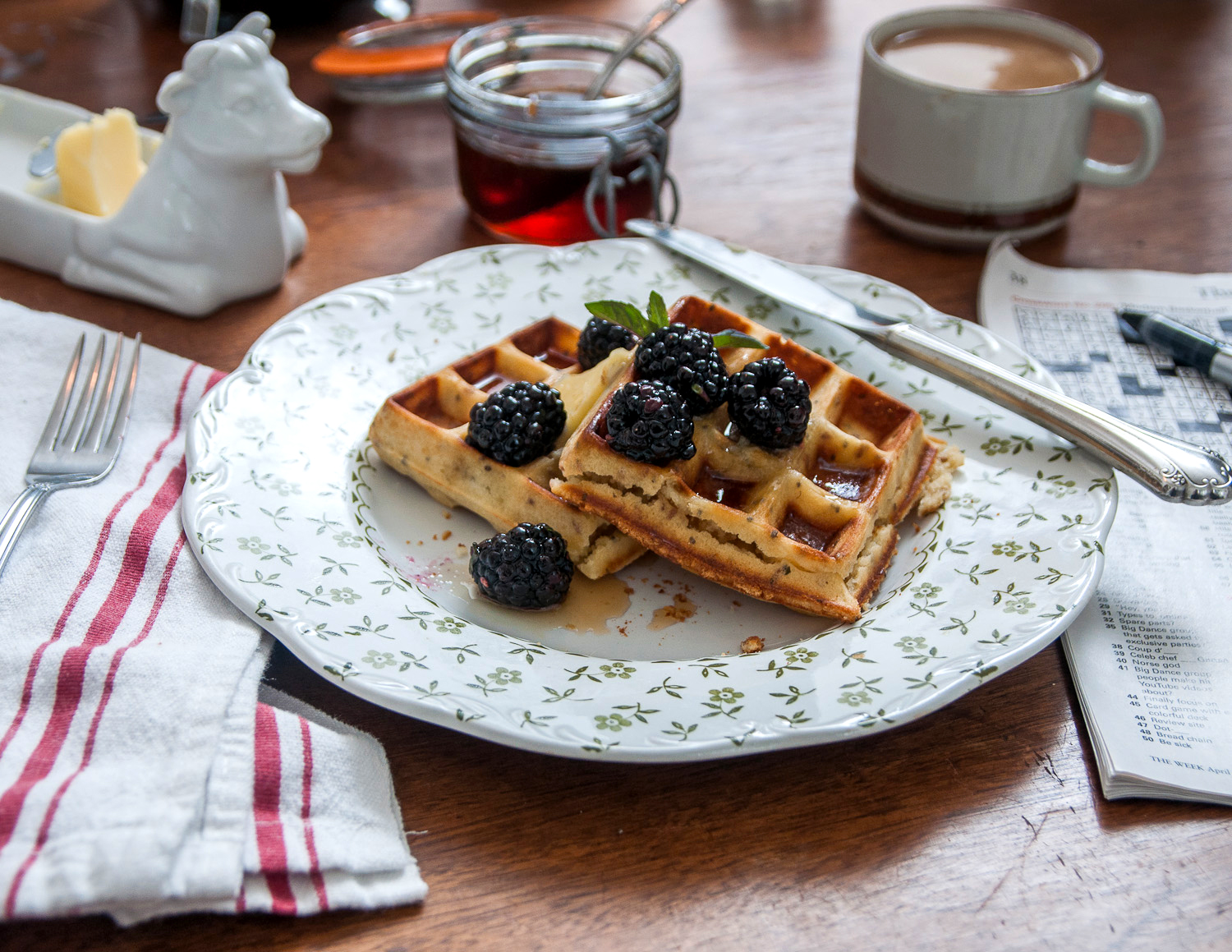
And as Fred prepared macerated blackberries with fresh mint to go on top, I began to heat up The Belgian Waffler for its maiden (at least in this decade, I would imagine) waffle voyage.

Though it's clearly been a very, very long time since I've had a meal of waffles, and I rarely opt for the sweet breakfast over the savory, I enjoyed this one immensely. The waffles were steamy warm, crisped light brown on the exterior, and substantial but moist inside. And they were only as sweet as what you put on top of them. I went for heavy on the butter and light on the maple syrup. We had the good stuff a neighbor brought back from Vermont. I enjoyed the texture and also the look that the seeds added. Fred piled his high with the sweetened berries and mint, in addition to the syrup. We cleaned our plates and then bickered over the last square.

There will be more waffles. I will make the recipes on the back of the box. But mostly, I keep thinking about using two waffle squares as sandwich bread...


Chia & Flax Seed Waffles with Blackberries & Fresh Mint

Waffles

Makes about 8 waffles

2 cups all-purpose flour
1 teaspoon salt
4 teaspoons baking powder
2 tablespoons sugar
2 eggs, room temperature
1 1/2 cups whole milk, warmed slightly
1/3 cup vegetable shortening, melted
1/3 cup (2/3 stick) unsalted butter, melted
1 tablespoon chia seeds
1 tablespoon flax seeds

Put the flour, salt, baking powder, and sugar in a mixing bowl and stir the mixture with a fork until blended.

In another bowl, beat the eggs well and stir in the milk. Combine with the flour mixture until mixed. Add the melted shortening and butter and beat until blended.

Blend in chia and flax seeds.

Pour about 3/4 cup batter into a very hot waffle iron. Bake the waffles until they are golden and crisp. Serve hot & top with macerated berries, butter & maple syrup. Or whatever you want.


Macerated Blackberries

2 cups fresh blackberries
1 tablespoon plus 2 teaspoons sugar
1 teaspoon shredded fresh mint

Combine blackberries, sugar, and mint. Refrigerate for 1 hour.


Three years ago: Potato Fennel Hash

Minggu, 24 Februari 2013

An inspirational GIVEAWAY!


This is a first here at F for Food, but that last post inspired me to do it. 

Recently, as I glanced across my vast cookbook collection, at all of the words and images that inspire me daily in the kitchen, I thought I might just pass some of that inspiration along to you. I recently attended an event in which Michael Psilakis did a cooking demonstration. While he showed us how to make Greek sliders, he spoke of his inspiration, his father, who always encouraged him to follow what he loved. Much like Chef Psilakis, I have been lucky enough to have two parents that have always fostered my creativity. No matter what. 

That night, I received an autographed(!)copy of his beautiful cookbook: How to Roast a Lamb. The recipes and photography are inspired and inspiring. And I want to give this very cookbook to one of you!

How to Enter How to Roast a LambGiveaway


This is a blog-comment giveaway.

1. Leave a comment on this post about something that has been inspirational to you.

2. Let me know how I can contact you (blog, email, Twitter handle, etc.) so I can track you down if you are selected!

3. Share this giveaway post with your friends on Facebook and/or Twitter because, after all, sharing is caring!

4.Everyone is welcome to comment to enter, but I can only ship this set of cookbooks within the U.S. for no other reason than it is heavy and expensive to ship. (If you’re outside the US and win, you just need to provide me with a US mailing address to send.)

This giveaway ends on Friday, March 8th at 5PM PST. 

Good luck!

Senin, 05 Desember 2011

The Three Must Buy Cookbooks of 2011

I always write a series of "best of" cookbook posts around this time of year. I've recommended a lot of cookbooks in 2011*, but there are three, you simply must add to your collection. They are written by three amazing women who I admire tremendously and feel honored to have gotten to interview or at least meet. They are not just wonderful cooks and writers but cultural anthropologists who dig deep into how people cook, preserving traditions and making food from other places accessible. These books would make great gifts, but really, I recommend buying them for your own collections, that's how good they are.

The Food of Spain
There are lots of books about Spanish food. I know, because I have plenty of them, but The Food of Spain
is truly the mother of all Spanish cookbooks with over 600 pages. It has stories, history--it's a true treasury that took years of work to complete. I know this because Claudia Roden told me about the work that went into the book when I interviewed her last year (Claudia Roden interview part 1 and 2)

I've said it before and I'll say it again, Claudia Roden's recipes work. They make sense and give just the right level of detail. In this massive tome she uncovers so many more recipes than what you will find in run of the mill restaurants. In The Food of Spain you will discover many fascinating cultures that have influenced Spanish cuisine and recipes both familiar and rare. It's as much a book about food as it is a cookbook.

Dishes you will want to try include Eggplant with Bechamel and Cheese, Fish Stew with Peppers and Tomatoes, Migas with Bacon, Onion Coca.


The Food of Morocco
What can I say about Paula Wolfert that hasn't already been said? She is the most well-known authority on Moroccan food and The Food of Morocco is one of her most important books. Having lived in Morocco for years, she has a depth of knowledge that is just unparalleled. But if you have spent any time with her, you will be struck by her genuine enthusiasm for capturing the details of the cuisine and her drive for perfection. Her recipes are meticulous. Like Claudia Roden, she goes well beyond the surface to discover the history and varied influences that make for such a rich cuisine. Her latest book is over 500 pages. You can read my interview with her from 2009 here.

The book also has plenty of tips and advice to help you get it right, from the different types of couscous to explanations as to why steaming is better than boiling. There are lots of shopping resources too.

Dishes you will want to try include Lamb with Onions, Riffian Split Pea Soup with Paprika Oil, Almonds and Hard Cooked Eggs, Double Cooked Red Chicken Marrakech Style, Barley Grits Couscous with Fresh Fava Beans


The Homesick Texan
It might seem surprising that I put Lisa Fain in the same category as Claudia Roden and Paula Wolfert, but if you spend some time at her blog or reading her wonderful cookbook, The Homesick Texan
, you will see why I do. Lisa Fain's passion and connection to her Texas heritage and food shines through in everything she writes. She treats the cuisine of Texas with such respect and warmth that you can't help but appreciate it too, even if you are not "homesick" for it.

Unlike Roden or Wolfert, Lisa Fain is not an outsider, but a native who shares her own personal stories. And if she can make Texas recipes work in a New York apartment kitchen you have to know they will work for you too. Her book is a little over 350 pages.

Dishes you will want to try include Calabacitas (Squash and Pork Stew), Poblano Macaroni and Cheese, Coffee Chipotle Oven Brisket and Watermelon Salsa.


*Other cookbooks I reviewed and recommended in 2011:
Cooking My Way Back Home, Kokkari, Bi-Rite Market's Eat Good Food, The Family Meal:Home Cooking with Ferran Adria, 100 Perfect Pairings, Basic to Brilliant, Y'all


The Homesick Texan and The Food of Spain were review copies, I purchased The Food of Morocco

Selasa, 01 November 2011

Cooking My Way Back Home, Kokkari & Bi-Rite Market's Eat Good Food

I always get excited about cookbooks with a connection to the Bay Area. There are so many things that make eating here special. Of course, it's the fresh produce, but it's much more than just that. It's also the vibe, the service and personality of our local restaurants. The latest crop of cookbooks capture much of that.

It may sound odd to say I don't go to Mitchell Rosenthal's restaurants, namely Town Hall and Anchor & Hope (never been to Salt House) primarily for the food. Oh the food is good, some of it is outstanding, but I really go because those restaurants just feel so good and welcoming. It's like a party every night, at both places, not in a rowdy way, in a "I can't remember the last time I had so much fun at a restaurant" way. At Town Hall I always sit at the communal table, and I love it. You cannot eat there without making friends with your neighbors and chatting over your dishes. Rosenthal's new cookbook, Cooking My Way Back Home, manages to share a lot of the fun through stories and photos, not to mention recipes.

Cooking My Way Back HomeThankfully my favorite dish from Town Hall is in the new cookbook, it's Faith's Warm Ham & Cheese Toast with Jalapeno Cream as well as my favorite bite from Anchor & Hope, Angels on Horseback with Remoulade. The recipes are a mix of Southern and Jewish/Deli favorites with a few Mexican, Seafood and barbecue recipes and somehow it all works. I'd call it comfort food meets party food. Bookmarked recipes to try include Hot Mixed Nuts with Truffle Honey and Maldon Salt, Sweet Onion and Funky Cheese Fondue, BBQ Shrimp with Toasted Garlic Bread and Lemon Chicken with Olive and Feta.

KokkariKokkari is hand's down the number one Greek restaurant in San Francisco. Of course, we are not a city known for Greek food. What makes the restaurant so successful is a classically trained chef who takes family recipes and elevates them to something even more special. The Kokkari cookbook is a compendium of Chef Erik Cosselmon's refined takes on Greek food and family recipes from the owners of the restaurant, the Frangadakis and Marcus (Moutsanas) families. Recipes you must try include the best Zucchini Cakes (fritters) I have ever had, Spiced Meatballs with Green Olive & Tomato Sauce, Orsa's Flaky Cheese Pastries, Braised Lamb Shanks and Moussaka.

Bi-Rite Market's Eat Good FoodEvery food writer I have spoken to lately is excited about Bi-Rite Market's Eat Good Food. Bi-Rite is one of the most incredible grocery stores you will ever visit. It is tiny and yet every single item that is there is there for a reason. It is the most curated store you can imagine. If you want to eat like we eat in the Bay Area, this is your book. It's not just recipes, it tells you just what you need to know about the ingredients you use. You'll learn how to store persimmons, how to use fresh fennel, how to buy heritage turkeys and where to best store cheese in your fridge. It also highlights many of the most beloved (mostly Northern California) producers and purveyors like McEvoy Ranch, Cowgirl Creamery and Mariquita Farms.

The book is like one of my other favorite cooking reference books, Zingerman's Guide to Good Eating, only on steroids because it includes so much more information, specifically about fresh meat, seafood, dairy, wines and a plethora of fresh produce. Read it and become an expert on choosing, storing and using the best ingredients possible. Recipes are really secondary, but some to whet your appetite include Cocoa-Cumin Beef Roast, Lemony Kale Caesar Salad, Spanish Deviled Eggs (to die for!) and Roasted Cauliflower and Brussels Sprouts with Caper Lemon Butter.

Local Author Events:

On November 17th Mitch Rosenthal of Town Hall will be speaking at Omnivore Books

On November 2nd Sam Mogannam of Bi-Rite will be speaking at the Commonwealth Club.

Thursday, November 3rd Erik Cosselmon of Kokkari will be teaching a demo class on rotisserie and roasting at Purcell Murray Brisbane