Search

Tampilkan postingan dengan label old school. Tampilkan semua postingan

Selasa, 25 Juni 2013

The Egg Man


Eggs. They are the new black. Or at least the new bacon. Eggs can be used in every type of meal in countless ways: sunny side up, scrambled, frittata'd or used to coat bread for French toast for breakfast, on top of a burger at lunch, deviled eggs for a snack, over roasted asparagus, in an avgolemono soup or used to make a pasta for dinner and even baked into cakes, cookies, whipped into meringues for dessert. You can have them soft, medium or hard boiled, or go for the sixty-two degree version. The options are endless.
And the types of eggs with which to play are also numerous: chicken eggs, duck eggs, quail eggs, ostrich eggs, fish eggs (roe and caviar). Think of the infinite creations and myriad of recipes using all manner of eggs. And, in every single type of regional cuisine, from Japanese to Italian to Israeli to every place.
I've got it: eggs are the little black dress of food. Dressed up or dressed down, accessorized or kept simple. A classic. A staple. And much like always wanting to have that little, black dress in your closet, one always wants eggs on hand in the refrigerator.
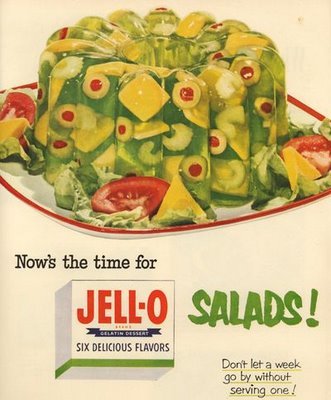
One iteration of the egg I haven't seen much of in recent memory (save for untouched in deli cases), but I grew up with, is egg salad. I know a lot of people get a little ooged out by proteins followed by the word salad: tuna salad, ham salad, chicken salad, shrimp salad, egg salad, and the grossest of all, Jell-o salad. Usually these salads involve mayonnaise as a binder, and there is a pretty substantial anti-mayo cult out there. This particular family of salads is also considered straight old school. It can be grouped into things like casserole, Betty Crocker and the like which dates back to the 1950s and 1960s.
Even though, theoretically, these salads should fall into the category of not suitable for packed lunches or picnics, what with the mayonnaise and the tuna fish and the eggs and all, that is exactly where they do fall. How many of you had one of these fill-in-the-blank salad sandwiches, wrapped tidily in wax paper in your lunch box or brown paper lunch bag? How many of you have had one of these fill-in-the-blank salads on sandwiches, crackers, on top of lettuce or just straight out of their container on a picnic? I am willing to bet quite a few.

My dad had to learn how to make shrimp salad in a home economics class in high school in the mid 1960s. He food poisoned himself. So I don't recall much of that around growing up. But, between Mom and Dad, there was a lot of tuna salad, chicken salad, and a weird-but-totally-delicious sandwich my mom packed for school lunch involving cream cheese and sliced green olives between two slices of bread. But, though I'm not sure why, my dad's egg salad always stood out to me. Whenever he made it, which was usually for a late-afternoon, dog days of Summer snack, I was thrilled.
Egg salad is one of those things I have never given mountains of thought. I could probably count on one hand the times I've ordered it out. But I order chicken and tuna salads often. And make them. And even more often, I order, and prepare at home, deviled eggs. And really, a deviled egg is pretty much the same thing as egg salad, but constructed differently.
As we have deemed June picnic month here at F for Food, andJune is when his birthday falls and, of course, Father's Day, I called my dad to find out his egg salad recipe to take on our next picnic. He made a couple of batches so he could recall his recipe-non-recipe and sent it forth.He wanted to let you know that either white or wheat bread is acceptable but the bread you choose MUST be a soft bread and it is certainly not to be toasted. And if you must add lettuce, tomato or bacon, feel free. But he won't be having any of that.


I left the recipe in his words since they are so extremely cute. Googier?! I love it.

Steve's Egg Salad
Makes enough egg salad for 3 or 4 sandwiches.
6 hard boiled eggs:
(Foolproof hard boiled eggs can be made as follows: Start the eggs in cold water, bring the water to a boil, then remove the pan from the heat, cover and let the eggs sit for 10 minutes.)
The cool or room temperature eggs are peeled and chopped up in a mixing bowl.  I use a fork and do a mixture of slicing and pressing to get my desired base. A mixer makes it too creamy.
Add and mix:
1/3 cup Duke's mayo. You can add a little more if you want it googier.
1 tablespoon brown spicy mustard
1/2 kosher dill pickle, finely chopped
1/4  teaspoon ground pepper, kosher salt & (secret ingredient) vinegar.
Bon appetite, y all.


Two years ago: Artichoke-Potato Hash

Kamis, 20 Juni 2013

Mom's Banana Cream Pie


OLD SCHOOL EASY BANANA CREAM PIE

homemade crust...always,

BUT the filling comes in a BOX
and the whipped topping comes in a CAN

no need to slave over "made-from-scratch" filling and fresh whipped cream..the pie will be gone before anyone is stupid enough to question your recipe,
BUT IF THE CRUST IS HOMEMADE YOU WILL GET EXTRA KUDOS FOR SURE.

simple, understated, always a favorite and it's pure comfort food.


MOM's BANANA CREAM PIE

one 9" inch pie crust...pre baked
homemade is best, but store bought will do in a pinch. i say...in a pinch!
1 large box vanilla pudding mix (8 serv. box).  NOT the instant mix
1 3/4 cups milk
1 tsp vanilla extract
2 ripe bananas...more or less for decoration
whipped cream for topping

mom is the pie crust chef around here.  she has never written down the actual recipe, but she uses a blend of unsalted butter with a little butter flavored Crisco as opposed to one OR the other or lard.  she uses the food processor to make the dough, wraps it in saran and stores it in the freezer for an impromptu pie bake.
to pre bake the shell we used Alton Brown's method...(click on the link for his full pie crust recipe.)      

when your dough is ready...form the dough in the pie plate and crimp the edges as you would for an apple pie.  cut a piece of parchment a bit bigger than the pie and place that on the uncooked shell.  fill with beans.  put the whole thing in the freezer for about 10 minutes just before you are going to bake.  then bake at 400F convection (425F regular oven) for 10 minutes.  remove the parchment and beans and cook 10-15 minutes longer or until golden brown.  let cool completely.

make pudding according to box, BUT only use 1 3/4 cups whole milk and add a 1 tsp of vanilla.  let this cool just a little bit.
cut banana circles and place them to cover the bottom of cooled pie shell.  pour pudding  evenly over bananas.  give it a "shimmy shimmy" to even it out.  cover with saran wrap touching the pudding and put in fridge to set.
you might choose to decorate the top with more bananas, but it is harder to get a "clean cut"...maybe just around the edge is best.  it is best to put extra bananas on just before serving or they will turn brown.  serve with whipped cream.
go ahead...buy a can and keep it in the back of the fridge.


they say...it's all about the crust.  that's why store bought doesn't cut it in this house.  luckily i have an expert to call on when a good pie is necessary.  take the time to make a few "dough-discs" and throw them in the freezer.  pull one out the night before and thaw in the fridge overnight...it should be ready to roll the next day.


sometimes imperfections are the best sign of "homemade"

Kamis, 30 Mei 2013

We Got the Beet.


Growing up we had a Patrick Nagel print hanging on a wall in the dining room. It's exactly the one you're thinking of. Or maybe not. A lot of them have that woman in them. You know, the woman on the cover of Duran Duran's Rio. I never much cared for it. Oh, I loved the album, just not the print hanging on the wall in our dining room. My dad really liked that whole style; that very 80s, minimalist, pastel thing. My dad really liked the 80s, in general. And the 80s liked my dad. They made sense together. He was newly single, very handsome, a great cook, liked to travel, play tennis, hang glide and party. And, of course, he was into the art.

Patrick Nagel was born in 1945. My dad was born in 1945. Patrick Nagel's work was greatly inspired by and directly descended from Art Deco. And Art Deco is, without a doubt, my dad's favorite visual design style. His house and work are both filled with furniture and light fixtures from the Deco era.

Unlike my dad, who is alive, healthy and happy, Patrick Nagel died at the peak of his life and career, at thirty-eight years of age. Strange as it sounds, immediately after participating in a fifteen minute celebrity 'Aerobithon' to raise money for the American Heart Association, Nagel was found dead in his car. From a heart attack. The Reagan Era was a bitch.

This past weekend I was in a fun, food frenzy in the kitchen. I just wanted to make stuff. I see some rhubarb. Let's make a cake! I see leftover coffee and a pork tenderloin. Let's make a marinade and grill stuff! I see beets and carrots. Let's make a borsch! I see Greek yogurt and horseradish. Let's make a garnish for the borsch! You get the idea.

The borsch came out so bright, saturated, rich and vivid that it immediately reminded me, visually, of Pop Art. Flashes of bright colors and sharp shapes from the works of Warhol, Lichtenstein, and yes, Nagel rushed through my head. Fred agreed, but his head was swimming with images of Bauhaus and Kandinsky. Which is totally appropriate for cold borsch as all three are/were Russian! And thus our Sunday unfolded into the eighties-inspired photoshoot of borsch. I did very little styling on this shoot. Fred really ran with it on his own. I picked the soundtrack: The Go-Go's. Right around the time that Nagel was at his peak, so were The Go-Go's. And right around that time I participated in a lip syncing 'class' at Summer camp. And our group's piéce de résistance was, you guessed it, 'We Got the Beat'. I was Belinda Carlisle and my tennis racket was my guitar. Though I'm pretty sure Belinda Carlisle did not actually play the guitar. Man, I miss my Swatch.

The bosrcht was quite good. A success. It was rich and bold with a rear kick of subtle heat from the white pepper and the horseradish yogurt. It was complex on the palate but finished very neatly. This innocent little soup also made a morbid mess of anything that came near it. We had so much left over that we took it up to a Memorial Day BBQ in the canyon. I think I saw one person try it. Who can blame them? At a cookout abundant with steaks, lamb, burgers, sausages, corn salad, chips, banana crème pudding and booze, who wants to deal with a bowl of borsch?

Ah, well. It's not for everyone. People kind of either love it or hate it. I'm not certain what Patrick Nagel liked to eat, but if he's anything like my dad, borsch was not high on the list. 

Me, I'll take a bowl any time.


Chilled Beet Soup with Horseradish Yogurt

Serves 4-6

4 cups (or more) chicken stock
1 pound beets, peeled, chopped
1 cup chopped onion
1 cup peeled chopped carrot
2 teaspoons chopped garlic
1 teaspoon sugar
1 bay leaf
2 tablespoons horseradish
A handful of fresh chives, trimmed
Greek yogurt
Generous salt & white pepper to taste


Combine 4 cups broth, beets, onions, carrot, bay leaf and garlic in medium saucepan. Bring to boil.

Reduce heat to medium-low; cover and simmer until vegetables are very tender, about 35 minutes. Cool slightly. Remove bay leaf and puree in blender in batches until smooth. Transfer to bowl.

Thin with additional stock if soup is too thick. Mix in sugar. Season with salt and pepper. Cover and chill until cold, at least 4 hours or overnight. (Can be prepared 2 days ahead. Keep refrigerated.)

Ladle soup into bowls.

In a small bowl, mix horseradish and yogurt. Put a dollop of horseradish mixture in the middle of the bowl of soup and top with chives.


Senin, 27 Mei 2013

Pucker Up.


I've been thinking about the handful of fruits and vegetables that we use in cooking but would never just pop into our mouths, fresh. I mean to say, foods that require a significant transformation for them to be edible, like olives, rhubarb and cranberries. Olives have to be fermented or cured, rhubarb has toxic leaves and is almost always macerated then baked. And cranberries, have you ever tried to just eat a cranberry? Not pleasant. And acorns. It has never even occurred to me to eat an acorn. Yet, it is a nut. Squirrels eat acorns. And throughout history acorns have been used, ground up to make grain flours and even used as a coffee substitute for soldiers in both the Civil War and World War II.

It fascinates me to no end to think of the trajectory of how we, the people, figured out how to make these things (and all things) edible. 'Well, Hyram there died when he ate that acorn. So let's try and soak it in another poisonous substance, LYE, and give it another go. Yes? Rodney's okay? Alright, good to hear because this would make a lovely flour with which to create a noodle.'

Rhubarb. It comes into season in the Spring and everyone gets all aflutter about it. I'd say about ninety percent of the time you'll find rhubarb paired with strawberries and baked into a pie or a crumble. It's bright, tart and guaranteed to make you pucker up. My favorite bit of information I stumbled across in my rhubarb research: In British theatre and early radio drama, the words "rhubarb rhubarb" were repeated for the effect of unintelligible conversation in the background. This usage lent its title to the 1969 film Rhubarb and its 1980 remake Rhubarb Rhubarb. I guess it's just about time for someone to make Rhubarb, Rhubarb, Rhubarb.

I haven't played with much rhubarb in my day. I could probably count on one hand, the number of times I've purchased any. And so, last time I found myself staring at produce at the market looking for inspiration, I grabbed a handful of those awkward, glossy, orangey, reddish-pinkish stalks and got to thinking. Even though I entertained some compelling arguments to go the savory route, which is generally more apropos for me, I knew pretty quickly that I was going to go sweet.
But a muted, subtle sweet.

Time to bake.

Though I am no cake connoisseur, I have always really loved coffee cakes and pound cakes. They are less cake-like and more akin to very sweet breads (not sweetbreads, mind you – wildly different things). Interestingly, both are also Southern. To this day, I would eat the Tasty Cake version of a coffee cake or the Sarah Lee version of a pound cake in a hot minute. The most beguiling part of coffee cake is the crumb on top. Those brown sugary, buttery grape-sized chunks on top of the cake that are toothachingly, cloyingly sweet – that almost requires a swallow of coffee to allay the sweetness – that's my jam.

And what better an element to cut that sweetness than the tartness of rhubarb?

I was right. When my cake cooled, we all dug in. The rhubarb, which had been macerated prior to baking, was mellow and gently sweet, but maintained it's pert zing, adding an ideal offset to the sugar bomb crumby coffee cake. Well, that and a cup of hot coffee.

And no one even had to die in the process. But Hyram, we certainly do thank you.


Rhubarb Crumb Coffee Cake

Serves 8


For the rhubarb filling:


1/2 pound rhubarb, trimmed

1/4 cup sugar

2 teaspoons cornstarch

1/2 teaspoon fresh, grated ginger

For the crumbs:


1/3 cup dark brown sugar

1/3 cup granulated sugar

1 teaspoon ground cinnamon

1/2 teaspoon fresh, grated ginger

1/8 teaspoon salt

1/2 cup (1 stick or 4 ounces) butter, melted

1 3/4 cups all-purpose flour

For the cake:


1/3 cup plain greek yogurt

1 large egg

1 large egg yolk

2 teaspoons vanilla extract

1 cup all-purpose flour

1/2 cup sugar

1/2 teaspoon baking soda

1/2 teaspoon baking powder

1/4 teaspoon salt

6 tablespoons softened butter, cut into 8 pieces.

Preheat oven to 325 degrees. Grease an 8-inch baking pan. For filling, slice rhubarb 1/2 inch thick and toss with sugar, cornstarch and ginger. Set aside.

To make crumbs, in a large bowl, whisk sugars, spices and salt into melted butter until smooth. Then, add flour with a spatula or wooden spoon. It will look and feel like a solid dough. Leave it pressed together in the bottom of the bowl and set aside.

To prepare cake, in a small bowl, stir together the yogurt, egg, egg yolk and vanilla. Using a mixer fitted with paddle attachment, mix together flour, sugar, baking soda, baking powder and salt. Add butter and a spoonful of sour cream mixture and mix on medium speed until flour is moistened. Increase speed and beat for 30 seconds. Add remaining sour cream mixture in two batches, beating for 20 seconds after each addition, and scraping down the sides of bowl with a spatula. Scoop out about 1/2 cup batter and set aside.

Scrape remaining batter into prepared pan. Spoon rhubarb over batter. Dollop set-aside batter over rhubarb; it does not have to be even.

Using your fingers, break topping mixture into big crumbs, about 1/2 inch to 3/4 inch in size. They do not have to be uniform, but make sure most are around that size. Sprinkle over cake. Bake cake until a toothpick inserted into center comes out clean of batter (it might be moist from rhubarb), 45 to 55 minutes. Cool completely before serving.


Two years ago: Yerp: Part 1 (of many).

Selasa, 02 April 2013

Consider the Waffle.


While ambling through a thrift store recently, I stumbled across a waffle iron touting itself as The Belgian Waffler. It gave me pause. Though I couldn't remember the last time I ordered a waffle from a menu, I knew for certain that, other than putting a frozen one into a toaster in or around the second grade, I had definitely had never made one. The colors and the font on the circa 1982 Belgian Waffler box reminded me, fondly, of Busch Gardens, an old-world European theme park back in Williamsburg, Virginia. The Old Country, as it was tagged, featured a number of 'hamlets' like Oktoberfest (Bavarian Germany), Killarney (Ireland), Heatherdowns (Scotland), Aquitaine (France) and Banbury Cross (England) to name a few, all with appropriately themed food, games and rides. For you Californians, if Solvang had skee ball and roller coasters, it would be a dead ringer for a hamlet in Busch Gardens.

And so, for a mere four dollars and ninety-nine cents, how could I not purchase this novelty kitchen tool that elicited so much nostalgia?


As I unpacked the day's treasures; two vintage pea green and ecru plates and a matching creamer made of genuine English china (must have been part of someone's wedding gift at some point), one ornate soup spoon, one floral Asian rice bowl and an old, wonky muted blue and white dish that I deemed a perfect pasta bowl, I stopped and stared at The Belgian Waffler. Once I got past another Busch Gardens flashback of taking the gondola lift from Banbury Cross to get to the Le Scoot Log Flume and then the steam train to get to Heatherdowns to ride the Loch Ness Monster, I contemplated the actual waffle iron and wondered:

What's the story with waffles? Who eats them? Who makes them at home? I think I miss Eggos. Should I go get some? I bet two of those would make great bread for a sandwich.

After some sleuthing I came across an article in Time magazine from November of 1999, covering the flooded Tennessee Kellogg plant that forced the company to ration its supplies for over six months. Apparently the shortage was called a “national calamity, further proof of global warming's reach, a sign of the apocalypse, evidence of a corporate conspiracy and a good opportunity to cash in.” (Witness the Katy, Texas, resident who posted a "rationed" box of Blueberry Eggos on eBay — "toaster not included.")

I guess we like our waffles.

I was not more than a little bit surprised to find the waffle's origin traced back to none other than ancient Greece. The original waffles were basically communion wafers called oublies made with grain flour and water, pressed between little irons embossed with Biblical scenes or allegorical designs.

From there, the waffle's journey is an interesting one. One of my personal favorite highlights of its trajectory involves a 16th century painting that not only shows waffles being cooked, but also features a man wearing three waffles strapped to his head, playing dice for waffles with a black-masked carnival-goer.

Detail from Pieter Bruegel's Het gevecht tussen Carnaval en Vasten - among the first known images of waffles.

In the 17thcentury sugar was so prohibitively expensive that waffles were pretty much reserved for only the fancies. And, finally, around the 18thcentury the word waffle first appeared in the English language and the recipe could be found in American, English, Dutch, Belgian, German and French versions. Rumor has it Thomas Jefferson even had waffle parties. Wild Man Jefferson, they must have called him.

By the early 20thcentury ye olde waffle craftsmen were diminishing and the waffle became something people primarily made at home. This decline was accelerated by the invention of the first electric waffle maker (GE), waffle mixes by the likes of Aunt Jemima and Bisquick and, of course, that wacky trio of brothers, the Dosas, who provided us with our favorite frozen specialty, the Eggo waffle. Bringing us back to me standing in the thrift store, thinking about putting a waffle in the toaster oven in or around the second grade.

Upon my research, I was pretty excited to learn that some of the very earliest French waffle recipes, dating back to the late 14th century, were savory ones; “Beat some eggs in a bowl, season with salt and add wine. Toss in some flour, and mix. Then fill, little by little, two irons at a time with as much of the paste as a slice of cheese is large. Then close the iron and cook both sides. If the dough does not detach easily from the iron, coat it first with a piece of cloth that has been soaked in oil or grease.” Some other variations explain how cheese is to be placed in between two layers of batter, or grated and mixed in to the batter. Wine? Cheese? Sounds right up my alley.

For my fist experience with The Belgian Waffler, I was going to use one of the recipes on the back of the box. But then I thought to check in on my all-time favorite breakfast maker, Marion Cunningham, for her advice. She has never, ever done me wrong. Not when I need to make biscuits, or granola, or muffins, or breakfast breads, or pancakes, or even pancakes with fruit. Never.


Plus, my logic reminded me that in the eye of the frozen waffle storm sweeping this country, in or around when I was in the second grade, was also exactly when Marion Cunningham actually took the time to make her family waffles for breakfast. Even more precious, in her description above the recipe she goes so far as to explain that this is “ideal for spur-of-the-moment breakfast when you haven't time for yeast-risen waffles”. I mean, come on. Often mornings for me in or around the second grade involved my dad gulping exactly a cup and a half of coffee (half decaf, half caf) while watching The Today Show, and then standing by the front door, impatiently, with a banana in hand as I was grabbing my waffle out of the toaster, smearing butter on it, wrapping it up in a paper towel so I could catch a ride to school. But only as far as his work, mind you. I walked the rest of the way eating my breakfast. Yeast-risen waffles, yeah right, Marion.

So, yes, I went with Marion's classic waffle recipe but I added a little health. A little now. I added some chia seeds and some flax seeds.

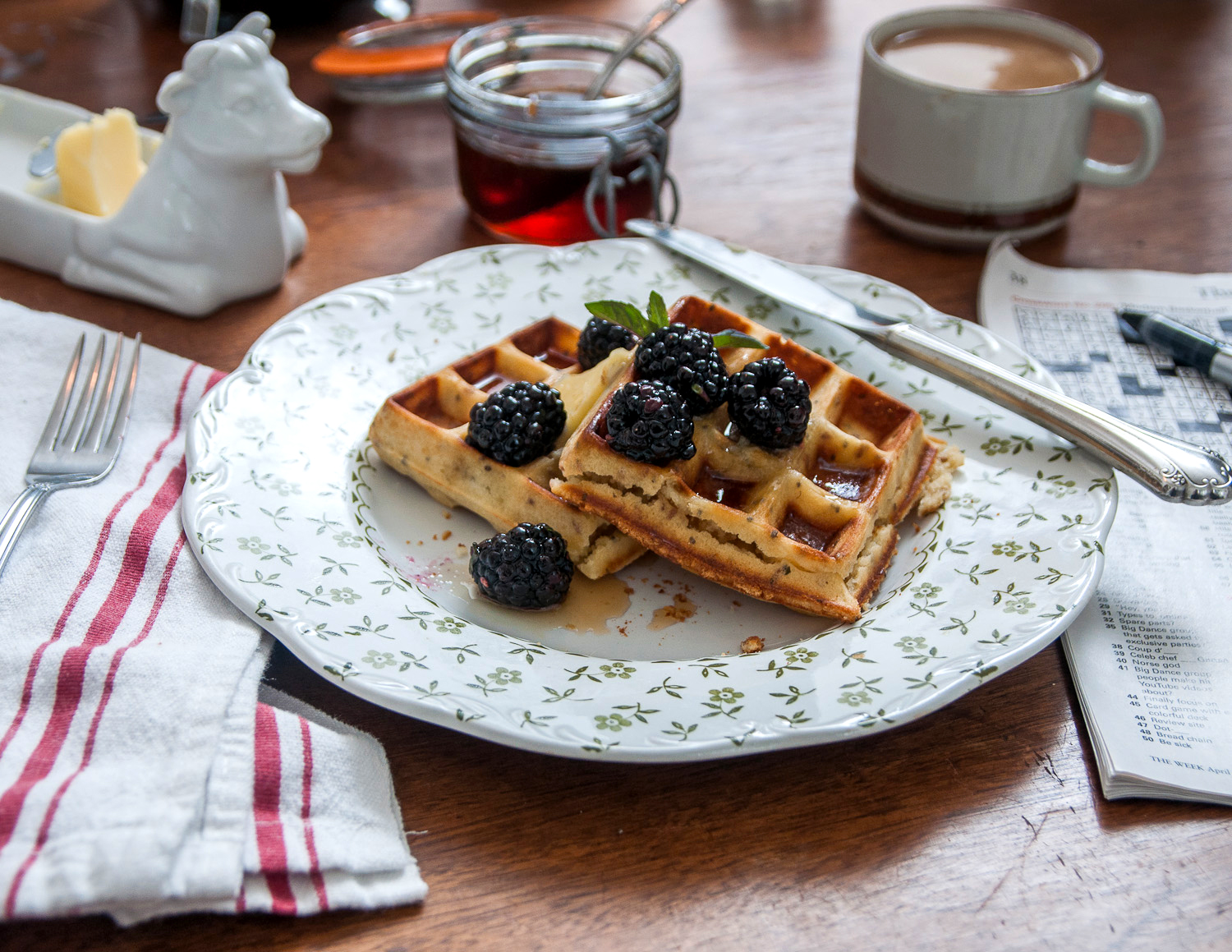
And as Fred prepared macerated blackberries with fresh mint to go on top, I began to heat up The Belgian Waffler for its maiden (at least in this decade, I would imagine) waffle voyage.

Though it's clearly been a very, very long time since I've had a meal of waffles, and I rarely opt for the sweet breakfast over the savory, I enjoyed this one immensely. The waffles were steamy warm, crisped light brown on the exterior, and substantial but moist inside. And they were only as sweet as what you put on top of them. I went for heavy on the butter and light on the maple syrup. We had the good stuff a neighbor brought back from Vermont. I enjoyed the texture and also the look that the seeds added. Fred piled his high with the sweetened berries and mint, in addition to the syrup. We cleaned our plates and then bickered over the last square.

There will be more waffles. I will make the recipes on the back of the box. But mostly, I keep thinking about using two waffle squares as sandwich bread...


Chia & Flax Seed Waffles with Blackberries & Fresh Mint

Waffles

Makes about 8 waffles

2 cups all-purpose flour
1 teaspoon salt
4 teaspoons baking powder
2 tablespoons sugar
2 eggs, room temperature
1 1/2 cups whole milk, warmed slightly
1/3 cup vegetable shortening, melted
1/3 cup (2/3 stick) unsalted butter, melted
1 tablespoon chia seeds
1 tablespoon flax seeds

Put the flour, salt, baking powder, and sugar in a mixing bowl and stir the mixture with a fork until blended.

In another bowl, beat the eggs well and stir in the milk. Combine with the flour mixture until mixed. Add the melted shortening and butter and beat until blended.

Blend in chia and flax seeds.

Pour about 3/4 cup batter into a very hot waffle iron. Bake the waffles until they are golden and crisp. Serve hot & top with macerated berries, butter & maple syrup. Or whatever you want.


Macerated Blackberries

2 cups fresh blackberries
1 tablespoon plus 2 teaspoons sugar
1 teaspoon shredded fresh mint

Combine blackberries, sugar, and mint. Refrigerate for 1 hour.


Three years ago: Potato Fennel Hash

Rabu, 27 Februari 2013

Comfort Me With Bucatini.


Growing up in Richmond, I recall very little pasta happening in either of my parents' kitchens, except maybe pasta salad. I also don't remember going out for much Italian food back then. I'm sure there was spaghetti and meatballs when I had dinner at my friends' houses, but – and I could be wrong – I don't think I ever saw it on my dining room table(s). That's weird, right? I mean, I don't even think we did lasagna, for crying out loud. It's a miracle I turned out alright.

That being said, there wasn't a ton of Italian food in my life for quite some time. After college, in the early Atlanta years, there were a couple of EYEtalian restaurants where I dined on occasion. By EYEtalian, I mean dimly lit rooms with red checker tablecloths, taper candles in old chianti bottles, dishes like eggplant parmigiana, veal scaloppini, chicken marsala, penne alla vodka (one of my favorite pasta dishes to this day), mostaccioli, linguine with clam sauce, baked ziti, lasagna, and spumoni or cannoli for dessert. Oh, and both kinds of wine: red and white.

Then in the last year or two there, a couple of Italian restaurants popped up that became game changers. For me, at least. Actually, it was really one restaurant that later became two with the same owner. The first born, Sotto Sotto, was the higher end version of its younger sibling, Fritti. It was at Sotto Sotto where a lot of things about Italian fare really evolved in my world. In a little restaurant in Inman Park, Atlanta, my palate got to travel from Southern to Northern Italy for the first time. I remember tasting delicate, handmade pastas of all shapes, sizes and consistencies, flecked with bright and fresh surprising accents like arugula, mint, and lemon or anchored down with braised, local duck with an aged twelve year balsamic. There were fresh truffles, walnut sauce and sage browned butter, which fifteen years ago was not something I saw on menus very often. I remember having the most delicate beef carpaccio I had ever tasted. The beef sliced so carefully, so thinly, that it essentially melted on my tongue. And then when the little sister, Fritti, came along, I was introduced to the lightest, freshest calamari fritti, garnished only with fresh lemon, and their crimini and portobello mushrooms, lightly fried in rice flour batter with white truffle oil. Most importantly, it was the first time I became acquainted with Neapolitan pizza. And burrata.

Best of all, I lived a mere two blocks away. Even bester, two of my girlfriends and my then boyfriend worked there.

And so an Italian food lover was born.

In the eleven years that I have lived here in LA, though, I don't make pasta at home as much as other things, I would say that my go to meal out is easily for Italian food. More often than not, what I crave is the Northern Italian fare; the fine handmade pastas with fresh, seasonal produce, nuanced flavors and elegant sauces, and almost always I will opt for Neapolitan pies to that of any other. That said, I would never turn down a dinner at Dan Tana's. Who wouldn't want a side of spaghetti with their spaghetti?


But here's the thing, a couple of years ago I came across a recipe in The Week for a dish called Cacio e Pepe. Its scant few ingredients and seemingly whimsical and simple process tempted me. The recipe called for a long pasta (in this case, bucatini), Parmesan cheese, extra virgin olive oil, Kosher salt and lots and lots of freshly cracked black pepper. After I tried to make it the first time, and failed, I started to read about the recipe. I realized that this dish exemplifies the complexity of pan sauce precision. Of course! This is one of those less-is-more, minimalist recipes by which cooks are measured – and as I read on, I learned that no two chefs agree on how to do it just right.

And, it's a Roman dish... making it kind of EYEtalian!

After that, my interest was piqued. If I saw it on a menu, I ordered it. And, for the most part, folks were using the bucatini. So, my only occasion, other than my own kitchen defeat, for both the bucatini and the cacio e pepe had been when dining out.

Then I met Fred. And on our third date, he invited me to his place to cook me dinner. I remember thinking, “Uh, oh. He has no idea what he's gotten himself into. Be nice, be nice, be nice.” Beyond all of the bells, whistles (the right kind, not the gaudy kind), and the ts crossed and is dotted, there he was, in his kitchen, with a YouTube video playing on his iPad illustrating how to make cacio e pepe. And before you ask, no, he had no idea. This was all Fred.

I remember thinking it was going to be a disaster. If I couldn't make it right, and it was such a cornerstone for great chefs, how was hegoing to do it?

It was perfect. It is still the best version of cacio e pepe (and with bucatini, mind you) I have had to date. I'm serious!

And so, not only did cacio e pepe become even more pivotal to me, but bucatini, in particular did as well. Unfortunately, I have only stumbled upon it a few times here in LA since I began this obsession. And I look. Once I saw it at the Silverlake Farmers' Market, but it seemed a little pricey. Anyway, on a recent trip to San Francisco, Fred and I poked into our favorite EYEtalian deli and grabbed every kind of bucatini they had. That would be five (5) different brands of bucatini.

And a couple of nights ago I made a dish with the prettiest and fanciest of our bucatinis. It was a type of a cacio e pepe, but I added shaved asparagus stalks, a single clove of garlic, some red pepper flakes, lemon and I topped everything with fresh breadcrumbs. I also used two cheeses; a Grana Padano, for its velvety texture, and Pecorino, for its sharpness. Other than adding the extras, the concept and the technique were no different than the original cacio e pepe.

I'd like to tell you how romantic it was that we made this, our very special dish together. I'd like it to seem like we savored that last strand of bucatini like the Lady and the Tramp. But we were really just so excited and so hungry, that we pretty much inhaled our big bowls of pasta and glasses of chianti. Just-a like-a Mama would-a like-a.


Bucatini with Shaved Asparagus & Fresh Breadcrumbs
Serves 4


Ingredients:
2 thick slices hearty bread, torn into about 1-inch pieces

extra virgin olive oil

1 pound bucatini

red pepper flakes

1 clove garlic, minced

2 bundles asparagus, shaved

The juice of 1 lemon

1/4 cup mixed grated Grana Padano & Pecorino cheeses
Kosher salt, and freshly cracked black pepper


Directions:
Preheat oven to 400 degrees.  Pulse bread in food processor to make bread crumbs.  Spread the crumbs on a small baking tray.  Drizzle with olive oil and a pinch of salt; toss.  Toast for 15 minutes, or until golden brown.
Meanwhile, bring a large pot of salted water to a boil.  Cook bucatini until al dente.  Reserve a bit of the cooking water.
Just before the pasta finishes cooking, heat about a tablespoon of olive oil in a skillet.  Add garlic and a pinch or two of red pepper flakes and cook until fragrant, about a minute.  Add asparagus and a pinch of salt; cook until the asparagus until slightly softened.  Add juice of the lemon.  Toss.
Add the cooked bucatini and parmesan to the skillet with the asparagus; toss to coat.  Add reserved cooking water a tablespoon at a time, if necessary, to achieve your desired consistency.  Serve, topped with toasted breadcrumbs.


Printable recipe.

One year ago: Grilled Oysters with Garlicky, Lemony, Buttery Sauce
Two years ago: I Left My Heart in San Fran-cheesy; Part 3, The Final Chapter
Three years ago: Chili with Beef & Bacon
Five years ago: Angelini Osteria

Senin, 11 Februari 2013

Coming Clean


While I was certainly no angel as a child, next to my childhood friend, Ben, I was definitely perceived as one. But he was a little boy and I was merely a little tomboy. Ben got into far more trouble than I ever did; invariably he would get caught.  I would often get caught but, clearly, far less.  Most of the Ben stories I have heard have come from our parents and these stories are based on incidents that took place circa the mid-1980's. 

One story, from the mouth of my dad, is one I not only recall well, but one in which I was a player. A sweet, little, innocent bystander, of course. So here's the story...

I guess it was around about 1985, and Dad had just done some work on the kitchen. Most notably he replaced the counter with an all new butcher block top. It was all shiny and new, with nary a cut mark in it. Ben's mom, Susan, was out for the evening and and so Ben was over at my house. We were just noodling around, goofing off, watching TV and whatnot. And honestly, it was so long ago, I don't know the how or the why, but I do know that I took the butcher knife and hacked a chunklet out of the edge of the new butcher block counter. I don't even remember if Ben was in the room at the time or not. I don't even know if Ben knows anything about this story, either.

Well, needless to say, the next day when Dad noticed the rather obvious, shall we say, blemish, on his new countertop, he went through the roof. And let me tell you, that man does not visibly agitate easily. When he actually erupts, you know it's really bad.

So clearly I blamed Ben. 

It seemed obvious that a rambunctious, rascally little boy who was always in some sort of trouble anyway would be the irrefutable culprit. Plus Ben wasn't there to defend himself, and we weren't hanging around as much in those days, and who would care or remember about a little nick in the counter for very long? Right? And my dad has a terrible memory to boot. Right?

Well, jeez. Who knew Dad was such a harborer? Yes, he stayed pretty irritated about the butcher block situation for a good long while. Cursing and mumbling under his breath as he ran his fingers over the disfigured area of the countertop. So I just kept quiet.

Then Ben and I went to separate middle schools, high schools, colleges, grew up, moved away, and I literally cannot even think of the last time we saw one another. So it hardly mattered anymore. To me.

Here is a glimpse of the countertop, but not the defaced part.

The last time I went home, Dad and I were standing in the kitchen, assembling a cheese plate and sipping on our glasses of crisp white wine, as I jokingly pointed out the nick in the countertop. Although it was something I had seen every time I did anything in the kitchen, it had become so much a part of the landscape, I had pretty much forgotten about its lore. But not Dad. He said every time he looked down at the aberration in the now, well-worn countertop, he cursed Ben's name. Though, he said, he never said anything to Susan or Ben about it.

I then realized it was time to come clean. He was shocked when he heard my story, but not more than just a little vexed thanks to time and that glass of wine. Plus, it's much more forgivable when it's your dear, sweet, innocent only child daughter...

And now we laugh about that funky little spot in the kitchen. It has a story to tell. It's part of the fabric – a sweet, anecdotal, minuscule imperfection.

When Susan was in LA recently to help Mom move back to Richmond, I decided to come clean to her, too. Although she never knew anything about the butcher block, I thought she should hear the tale. If nothing else to sort of exonerate Ben from his mischievous rep as a child and to fess up about my angelic one (or lack thereof). We laughed, but she did agree, Ben really did take the heat for a lot of stuff: some valid and some, maybe not so much.

Only one person left: I must confess to Ben and receive his forgiveness. So I emailed both Ben and Susan to find out what Ben's most favorite dish was. They both said broccoli casserole. I then emailed Susan and got the recipe. She emailed me back promptly with the recipe that she unearthed. It was her grandmother's recipe in her mother's handwriting. The recipe was as one would expect; ingredients like mayonnaise, a can of cream of mushroom soup, Ritz crackers, and the like. My mission was to make the recipe as authentic as possible without using mayonnaise, a can of cream of mushroom soup, or Ritz crackers. I wanted to keep the integrity of the dish but try to vamp it up for 2013.

I began by making a roux and adding fresh mushrooms, and then slowly adding cream until it was about the consistency and quantity of a can of cream of mushroom soup. I also added a splash of sherry for good measure. In lieu of the mayo, I simply used cream. And finally, to substitute the Ritz crackers, I used fresh bread crumbs. Now, I'm sure it would be way more yummy and fun, and would totally satisfy that like-grandma-made-when-I-was-a-kid thing most of us have, to use mayonnaise, a can of cream of mushroom soup, and Ritz crackers, but this turned out beautifully. Fred and I basically ate that, and nothing else, for dinner last night. And later as a snack.

Later this week, we will be traveling up to Northern California for a little respite, and plan on staying one night in San Francisco, where Ben now lives with his wife. And so in person I can share the story of The 25 Year Long Mystery of The Butcher Block with him. And hopefully we will laugh together over it. If not, Ben, here is the recipe your mom shared with me for your favorite, cozy, homey food, exactly as your grandmother wrote it and made it. That makes it all right, right?

Mimi’s Baked Broccoli

(Mimi is Sara in this instance)
(in Mother’s handwriting, so I know this is the one Ben likes)

Serves 4

Ingredients:

2 large heads of broccoli, if using fresh (2 packages chopped broccoli, if using frozen)
1 can cream of mushroom soup
½ cup mayonnaise
1 small onion, minced
1 Tablespoon lemon juice
1 egg
½-3/4 cup cheddar cheese
½-3/4 cup cracker crumbs (can use cheese crackers, saltines, or Ritz – I used Ritz)

Directions:

Preheat oven to 350 degrees.

Make sauce by mixing 1 can of undiluted soup, mayonnaise, onion, lemon juice, and egg.
Add a little salt and pepper.

Steam the broccoli for a few minutes if cooking fresh florets with short stems (don’t cook it until soft, but until it softens a small amount). If using frozen chopped broccoli, thaw only.

In casserole, put a layer of broccoli (one-half of it), then a layer of the sauce (one-half of it). Next, put in a layer of remaining broccoli topped with remaining sauce. Put ½ of crackers on top, the cheese, then ½ of remaining crackers.

Bake for about 30 min. at 350 degrees.


Three years ago: French Red Pepper Soup
Five years ago: Yang Chow